How big is my impact when choosing to resell or buying second hand? You can’t influence your device’s past. Perhaps it’s very old, broken or maybe it’s still good. But you can influence its story from today on. The decision tree below helps you see the impact your actions have.
You want a new laptop without going bankrupt. Let us tell you what your best options are. Your savings compared to new:
.png)
Some more information and some extra context can be written here. Maybe an important assumption is told here. Or maybe some sources are mentioned. Or maybe a link is added to a report where the methodology is explained.
So, you want a new phone without going bankrupt or frying the planet. Let us tell you what your options are and what your personal impact is, compared to buying new.


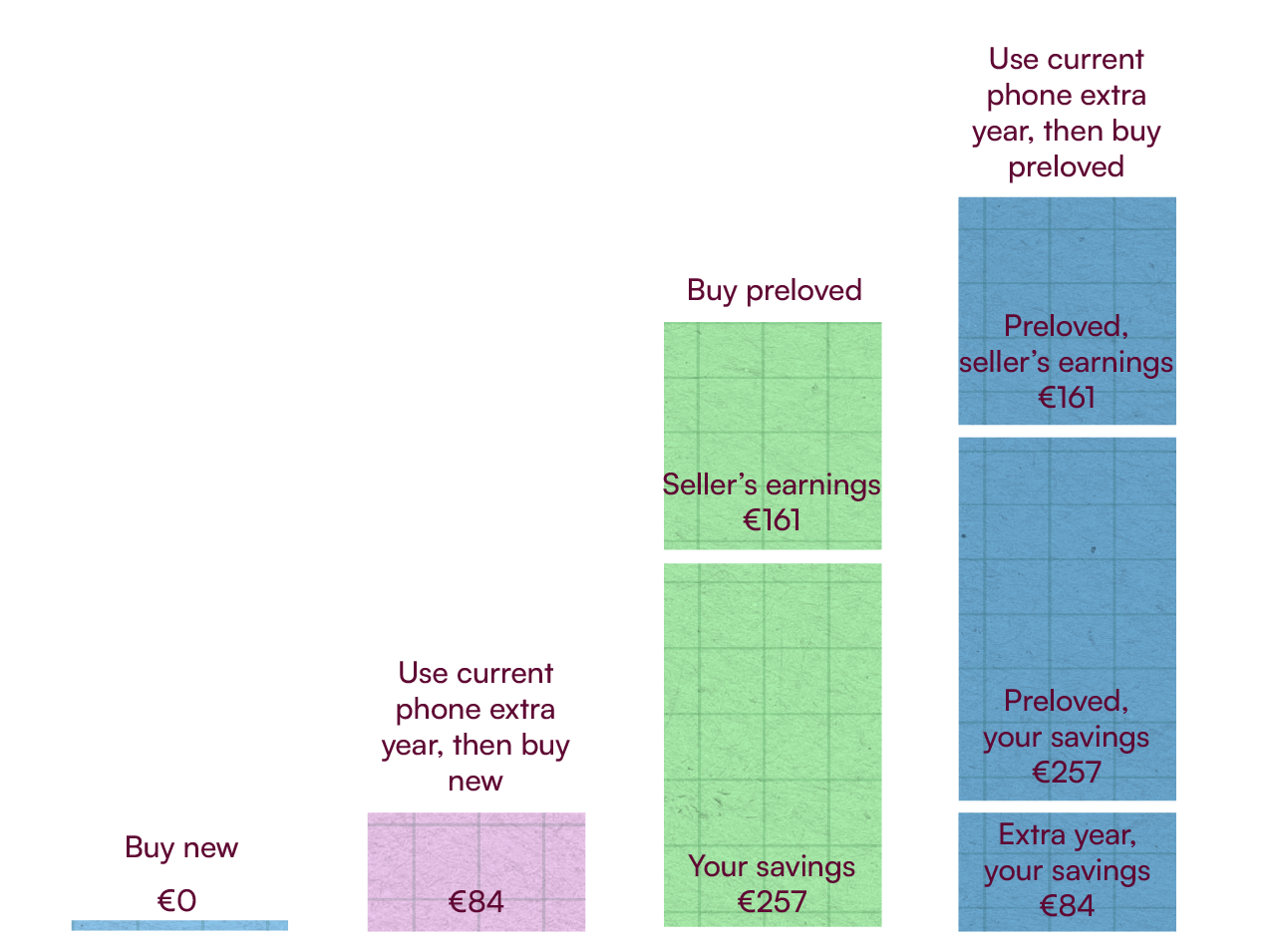
As you see, you save money (compared to buying a new product) and you help the seller earn some money (the price you pay them). Double win!
First, we calculated the impact of producing a phone, from ‘cradle to grave’: from resources all the way to waste treatment.
The prevented impact of preloved electronics is then calculated using the lifespan extension method: we don’t assume that every preloved item traded prevents 1 new item of being produced, transported and disposed of (because that’s not a conservative assumption). Rather, we assume that the production of a new item is postponed by a few years. This way, a certain percentage of the lifecycle impact of a new item is prevented, not the entire impact.
For example, a 4-year-old smartphone is sold. You use it for another 2 years. Then 50% was added to the initial lifespan, and 50% of its impact was ‘saved’: 2 divided by 4.
We know the technical lifespan of devices, and we also know at what age they’re sold on average on OLX. So we also know the extended lifespan: when a phone is still good, we assume that trade extends its lifespan by 64%. Of course, we don’t know the exact phone model and age you aim to buy. The numbers you see here are for the average smartphone traded on OLX between ’21 and ‘24.
The impact of the so-called use phase is not included, since we assume that electricity consumption associated with using a preloved device is equal to that of new ones.
You could argue that buyer and seller both enable a trade, so the impact savings can be attributed to them 50/50. However, we think a better approach is to allocate the impact savings based on duration of use. So if the first user sells the phone after 2 years and the buyer uses it for another 4 years, then we assign 2/6th part (33%) of the impact savings to the seller and 4/6th (67%) to the buyer.
With every extra year you use an item, you postpone the purchase (and thus the demand for, and thus the production of) a new item. If the technical lifespan of an item is 6 years and you use your current device for another year before buying another one, then technically, you save 1/6th part of the impact of a new product.
As you see, you save money (compared to buying a new product) and you help the seller earn some money (the price you pay them). Double win!
First, we calculated the impact of producing a phone, from ‘cradle to grave’: from resources all the way to waste treatment.
The prevented impact of preloved electronics is then calculated using the lifespan extension method: we don’t assume that every preloved item traded prevents 1 new item of being produced, transported and disposed of (because that’s not a conservative assumption). Rather, we assume that the production of a new item is postponed by a few years. This way, a certain percentage of the lifecycle impact of a new item is prevented, not the entire impact.
For example, a 4-year-old smartphone is sold. You use it for another 2 years. Then 50% was added to the initial lifespan, and 50% of its impact was ‘saved’: 2 divided by 4.
We know the technical lifespan of devices, and we also know at what age they’re sold on average on OLX. So we also know the extended lifespan: when a phone is still good, we assume that trade extends its lifespan by 64%. Of course, we don’t know the exact phone model and age you aim to buy. The numbers you see here are for the average smartphone traded on OLX between ’21 and ‘24.
The impact of the so-called use phase is not included, since we assume that electricity consumption associated with using a preloved device is equal to that of new ones.
You could argue that buyer and seller both enable a trade, so the impact savings can be attributed to them 50/50. However, we think a better approach is to allocate the impact savings based on duration of use. So if the first user sells the phone after 2 years and the buyer uses it for another 4 years, then we assign 2/6th part (33%) of the impact savings to the seller and 4/6th (67%) to the buyer.
With every extra year you use an item, you postpone the purchase (and thus the demand for, and thus the production of) a new item. If the technical lifespan of an item is 6 years and you use your current device for another year before buying another one, then technically, you save 1/6th part of the impact of a new product.
So, you want a new tablet without going bankrupt or frying the planet. Let us tell you what your options are and what your personal impact is, compared to buying new.
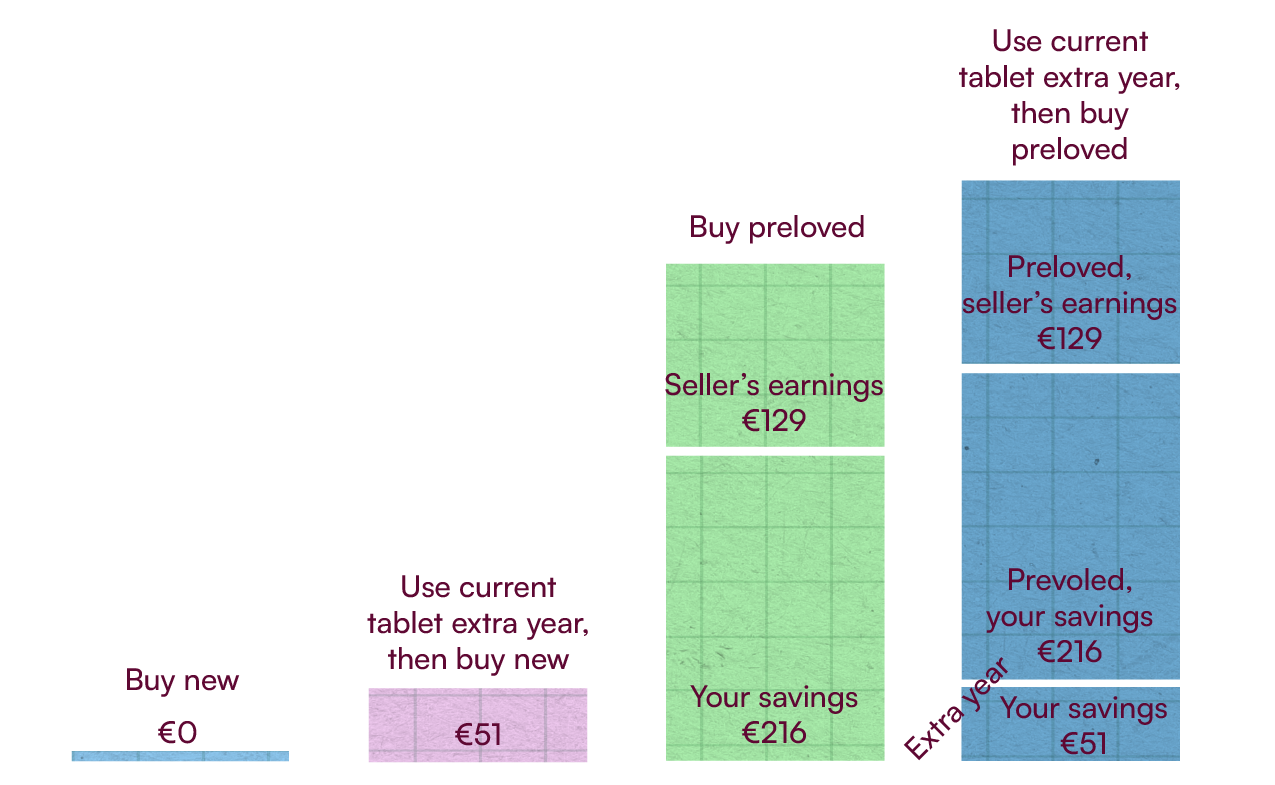
As you see, you save money (compared to buying a new product) and you help the seller earn some money (the price you pay them). Double win!
First, we calculated the impact of producing a tablet, from ‘cradle to grave’: from resources all the way to waste treatment.
The prevented impact of preloved electronics is then calculated using the lifespan extension method: we don’t assume that every preloved item traded prevents 1 new item of being produced, transported and disposed of (because that’s not a conservative assumption). Rather, we assume that the production of a new item is postponed by a few years. This way, a certain percentage of the lifecycle impact of a new item is prevented, not the entire impact.
For example, a 4-year-old tablet is sold. You use it for another 2 years. Then 50% was added to the initial lifespan, and 50% of its impact was ‘saved’: 2 divided by 4. We know the technical lifespan of devices, and we also know at what age they’re sold on average on OLX. So we also know the extended lifespan: when a tablet is still good, we assume that trade extends its lifespan by 75%. Of course, we don’t know the exact tablet model and age you aim to buy. The numbers you see here are for the average tablet traded on OLX between ’21 and ‘24.
The impact of the so-called use phase is not included, since we assume that electricity consumption associated with using a preloved device is equal to that of new ones.
You could argue that buyer and seller both enable a trade, so the impact savings can be attributed to them 50/50. However, we think a better approach is to allocate the impact savings based on duration of use. So if the first user sells the tablet after 2 years and the buyer uses it for another 4 years, then we assign 2/6th part (33%) of the impact savings to the seller and 4/6th (67%) to the buyer.
With every extra year you use an item, you postpone the purchase (and thus the demand for, and thus the production of) a new item. If the technical lifespan of an item is 6 years and you use your current device for another year before buying another one, then technically, you save 1/6th part of the impact of a new product.
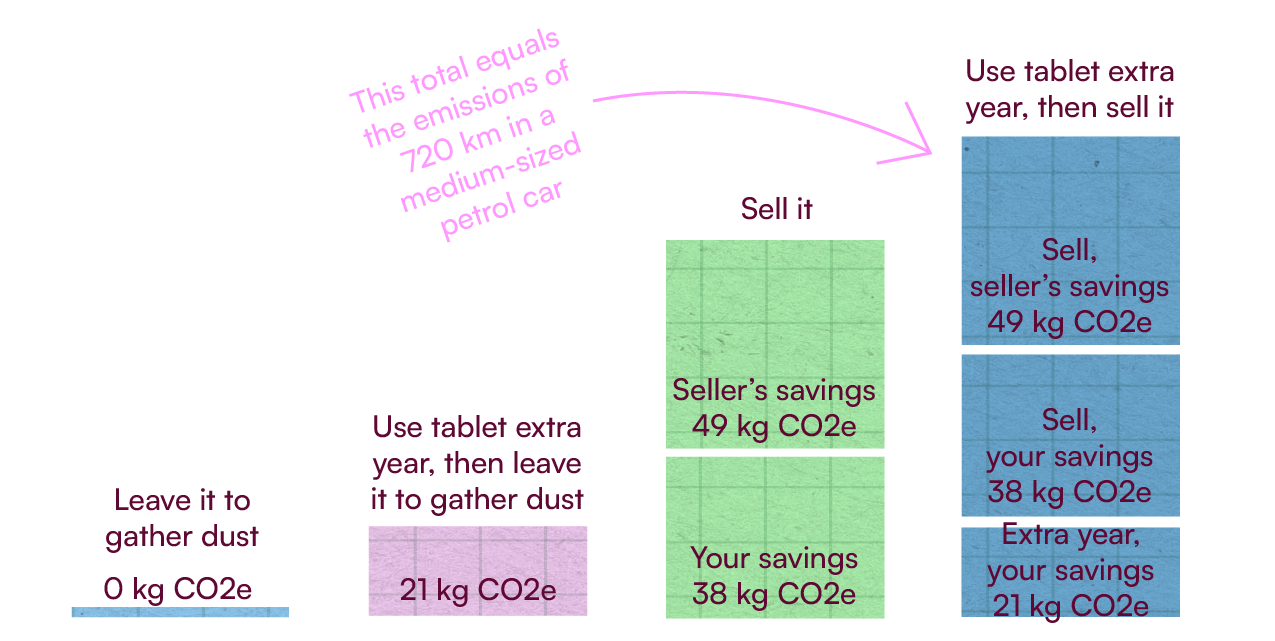
As you see, you save money (compared to buying a new product) and you help the seller earn some money (the price you pay them). Double win!
First, we calculated the impact of producing a tablet, from ‘cradle to grave’: from resources all the way to waste treatment.
The prevented impact of preloved electronics is then calculated using the lifespan extension method: we don’t assume that every preloved item traded prevents 1 new item of being produced, transported and disposed of (because that’s not a conservative assumption). Rather, we assume that the production of a new item is postponed by a few years. This way, a certain percentage of the lifecycle impact of a new item is prevented, not the entire impact.
For example, a 4-year-old tablet is sold. You use it for another 2 years. Then 50% was added to the initial lifespan, and 50% of its impact was ‘saved’: 2 divided by 4.
We know the technical lifespan of devices, and we also know at what age they’re sold on average on OLX. So we also know the extended lifespan: when a tablet is still good, we assume that trade extends its lifespan by 75%. Of course, we don’t know the exact tablet model and age you aim to buy. The numbers you see here are for the average tablet traded on OLX between ’21 and ‘24.
The impact of the so-called use phase is not included, since we assume that electricity consumption associated with using a preloved device is equal to that of new ones.
You could argue that buyer and seller both enable a trade, so the impact savings can be attributed to them 50/50. However, we think a better approach is to allocate the impact savings based on duration of use. So if the first user sells the tablet after 2 years and the buyer uses it for another 4 years, then we assign 2/6th part (33%) of the impact savings to the seller and 4/6th (67%) to the buyer.
With every extra year you use an item, you postpone the purchase (and thus the demand for, and thus the production of) a new item. If the technical lifespan of an item is 6 years and you use your current device for another year before buying another one, then technically, you save 1/6th part of the impact of a new product.
So, you want a new laptop without going bankrupt or frying the planet. Let us tell you what your options are and what your personal impact is, compared to buying new.
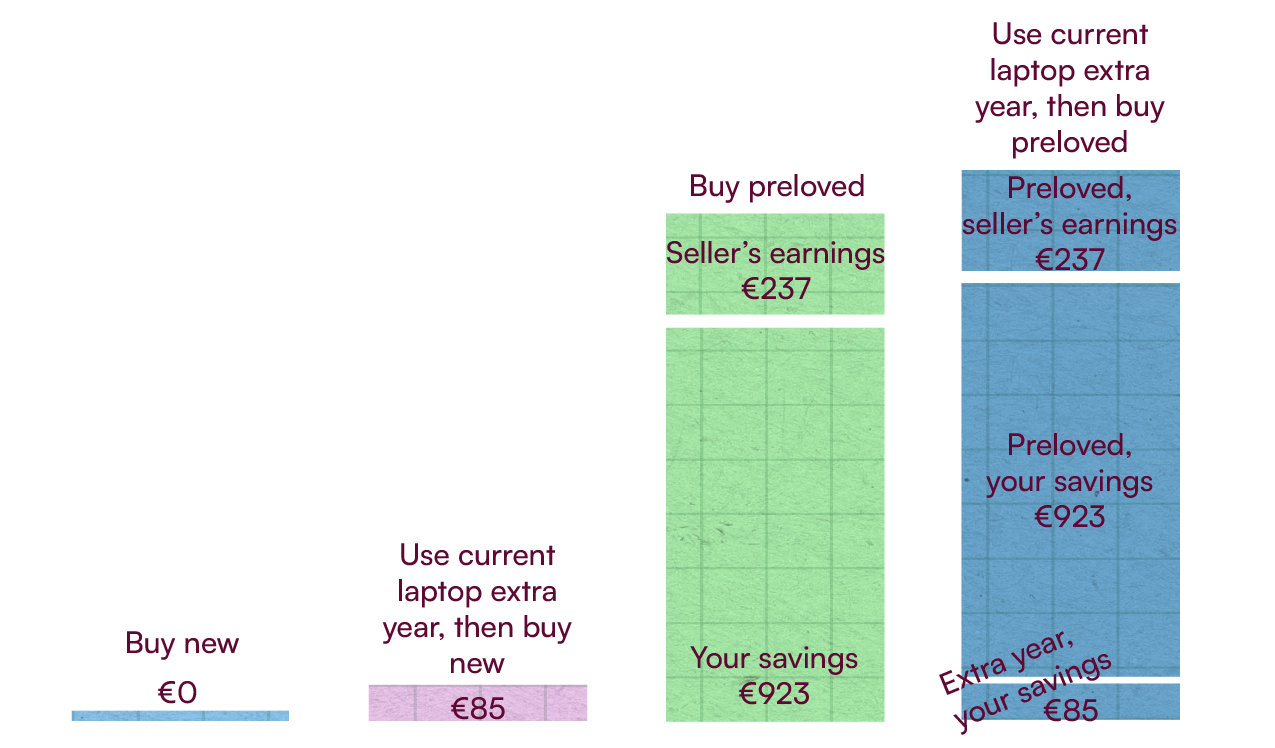
As you see, you save money (compared to buying a new product) and you help the seller earn some money (the price you pay them). Double win!
First, we calculated the impact of producing a laptop, from ‘cradle to grave’: from resources all the way to waste treatment.
The prevented impact of preloved electronics is then calculated using the lifespan extension method: we don’t assume that every preloved item traded prevents 1 new item of being produced, transported and disposed of (because that’s not a conservative assumption). Rather, we assume that the production of a new item is postponed by a few years. This way, a certain percentage of the lifecycle impact of a new item is prevented, not the entire impact.
For example, a 4-year-old laptop is sold. You use it for another 3 years. Then 75% was added to the initial lifespan, and 75% of its impact was ‘saved’: 3 divided by 4.
We know the technical lifespan of devices, and we also know at what age they’re sold on average on OLX. So we also know the extended lifespan: when a laptop is still good, we assume that trade extends its lifespan by 92%. Of course, we don’t know the exact laptop model and age you aim to buy. The numbers you see here are for the average laptop traded on OLX between ’21 and ‘24.
The impact of the so-called use phase is not included, since we assume that electricity consumption associated with using a preloved device is equal to that of new ones.
You could argue that buyer and seller both enable a trade, so the impact savings can be attributed to them 50/50. However, we think a better approach is to allocate the impact savings based on duration of use. So if the first user sells the laptop after 2 years and the buyer uses it for another 4 years, then we assign 2/6th part (33%) of the impact savings to the seller and 4/6th (67%) to the buyer.
With every extra year you use an item, you postpone the purchase (and thus the demand for, and thus the production of) a new item. If the technical lifespan of an item is 6 years and you use your current device for another year before buying another one, then technically, you save 1/6th part of the impact of a new product.

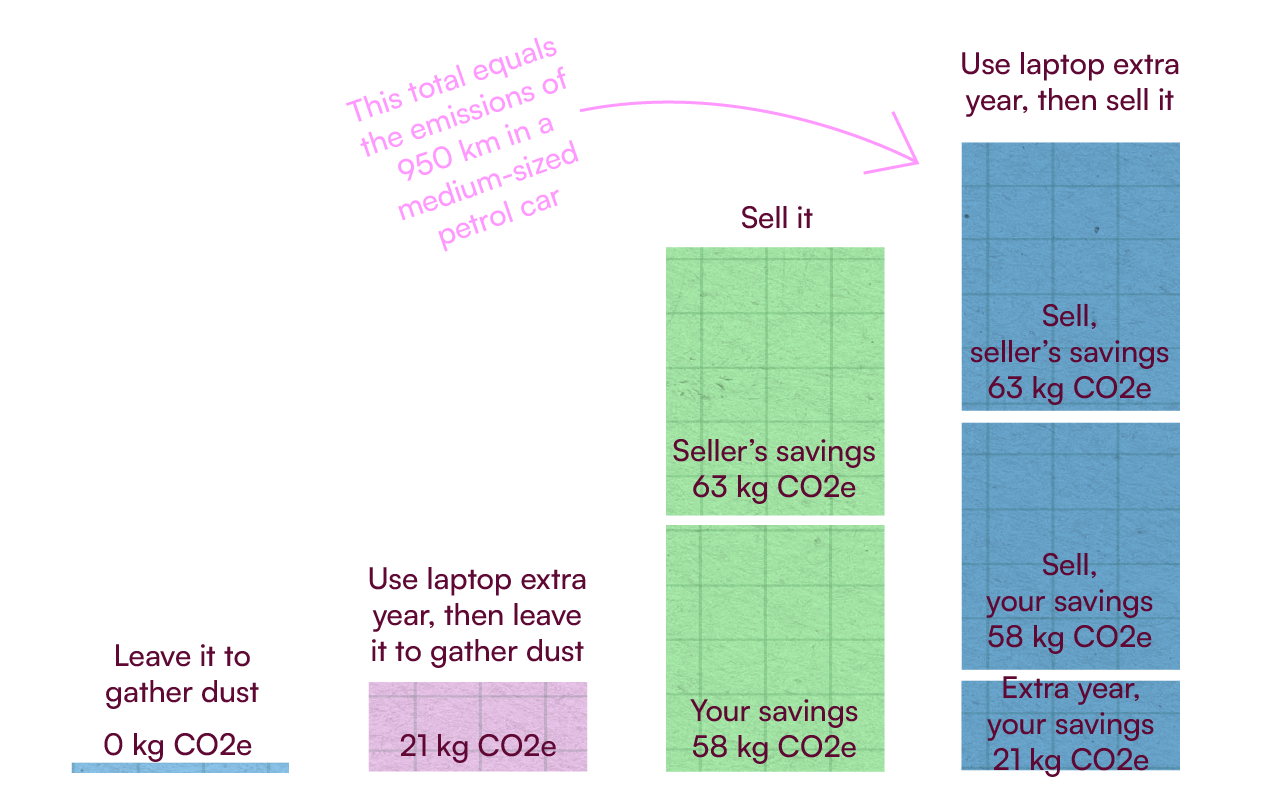
As you see, you save money (compared to buying a new product) and you help the seller earn some money (the price you pay them). Double win!
First, we calculated the impact of producing a laptop, from ‘cradle to grave’: from resources all the way to waste treatment.
The prevented impact of preloved electronics is then calculated using the lifespan extension method: we don’t assume that every preloved item traded prevents 1 new item of being produced, transported and disposed of (because that’s not a conservative assumption). Rather, we assume that the production of a new item is postponed by a few years. This way, a certain percentage of the lifecycle impact of a new item is prevented, not the entire impact.
For example, a 4-year-old laptop is sold. You use it for another 3 years. Then 75% was added to the initial lifespan, and 75% of its impact was ‘saved’: 3 divided by 4.
We know the technical lifespan of devices, and we also know at what age they’re sold on average on OLX. So we also know the extended lifespan: when a laptop is still good, we assume that trade extends its lifespan by 92%. Of course, we don’t know the exact laptop model and age you aim to buy. The numbers you see here are for the average laptop traded on OLX between ’21 and ‘24.
The impact of the so-called use phase is not included, since we assume that electricity consumption associated with using a preloved device is equal to that of new ones.
You could argue that buyer and seller both enable a trade, so the impact savings can be attributed to them 50/50. However, we think a better approach is to allocate the impact savings based on duration of use. So if the first user sells the laptop after 2 years and the buyer uses it for another 4 years, then we assign 2/6th part (33%) of the impact savings to the seller and 4/6th (67%) to the buyer.
With every extra year you use an item, you postpone the purchase (and thus the demand for, and thus the production of) a new item. If the technical lifespan of an item is 6 years and you use your current device for another year before buying another one, then technically, you save 1/6th part of the impact of a new product.
So, you want a new TV without going bankrupt or frying the planet. Let us tell you what your options are and what your personal impact is, compared to buying new.
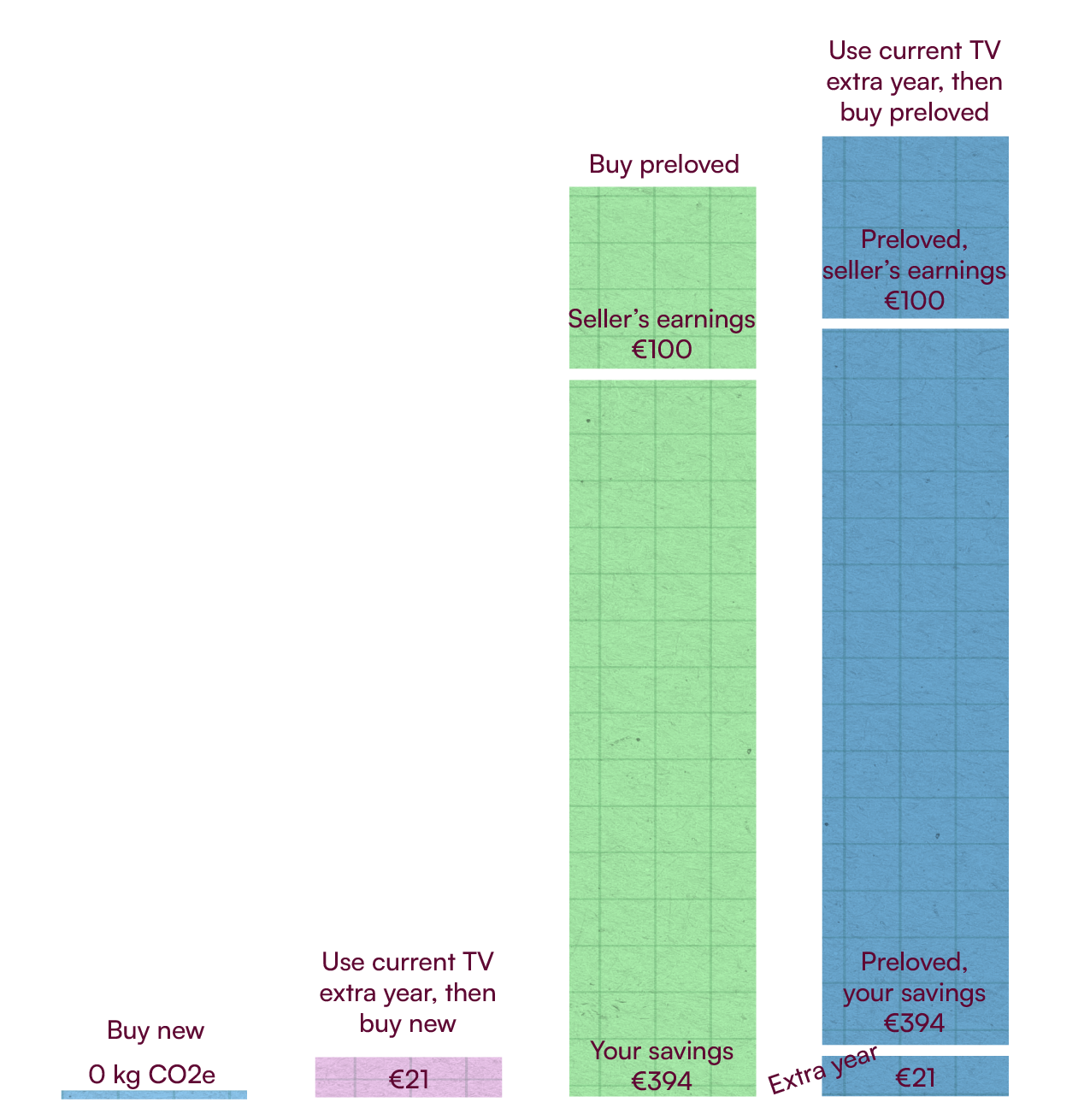
As you see, you save money (compared to buying a new product) and you help the seller earn some money (the price you pay them). Double win!
First, we calculated the impact of producing a phone, from ‘cradle to grave’: from resources all the way to waste treatment.
The prevented impact of preloved electronics is then calculated using the lifespan extension method: we don’t assume that every preloved item traded prevents 1 new item of being produced, transported and disposed of (because that’s not a conservative assumption). Rather, we assume that the production of a new item is postponed by a few years. This way, a certain percentage of the lifecycle impact of a new item is prevented, not the entire impact.
For example, a 6-year-old TV is sold. You use it for another 2 years. Then 33% was added to the initial lifespan, and 33% of its impact was ‘saved’: 2 divided by 6.
We know the technical lifespan of devices, and we also know at what age they’re sold on average on OLX. So we also know the extended lifespan: when a TV is still good, we assume that trade extends its lifespan by 61%. Of course, we don’t know the exact TV model and age you aim to buy. The numbers you see here are for the average TV traded on OLX between ’21 and ‘24.
The impact of the so-called use phase is not included, since we assume that electricity consumption associated with using a preloved device is equal to that of new ones.
You could argue that buyer and seller both enable a trade, so the impact savings can be attributed to them 50/50. However, we think a better approach is to allocate the impact savings based on duration of use. So if the first user sells the TV after 2 years and the buyer uses it for another 4 years, then we assign 2/6th part (33%) of the impact savings to the seller and 4/6th (67%) to the buyer.
With every extra year you use an item, you postpone the purchase (and thus the demand for, and thus the production of) a new item. If the technical lifespan of an item is 11 years and you use your current device for another year before buying another one, then technically, you save 1/11th part of the impact of a new product.
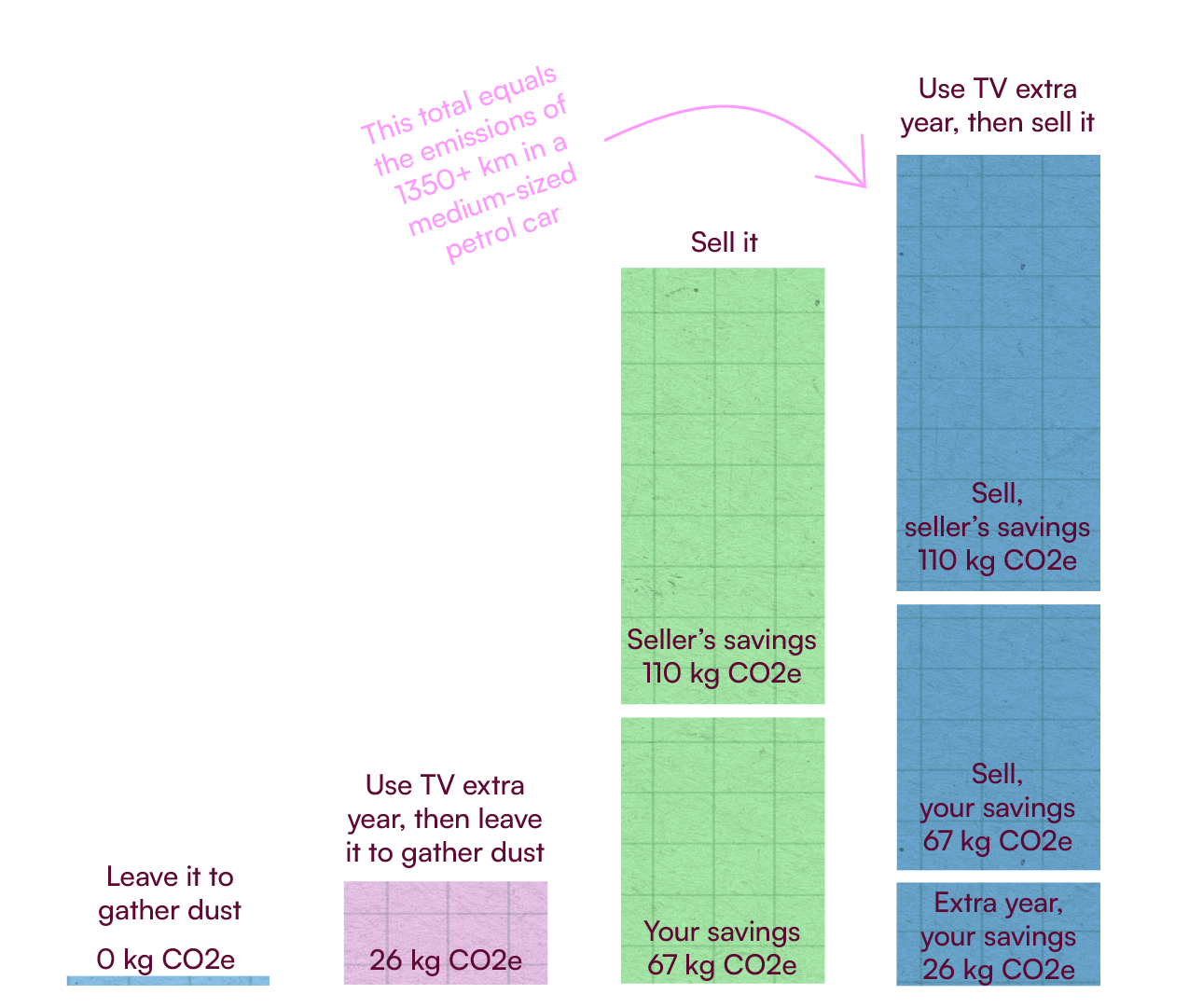
As you see, you save money (compared to buying a new product) and you help the seller earn some money (the price you pay them). Double win!
First, we calculated the impact of producing a phone, from ‘cradle to grave’: from resources all the way to waste treatment.
The prevented impact of preloved electronics is then calculated using the lifespan extension method: we don’t assume that every preloved item traded prevents 1 new item of being produced, transported and disposed of (because that’s not a conservative assumption). Rather, we assume that the production of a new item is postponed by a few years. This way, a certain percentage of the lifecycle impact of a new item is prevented, not the entire impact.
For example, a 6-year-old TV is sold. You use it for another 2 years. Then 33% was added to the initial lifespan, and 33% of its impact was ‘saved’: 2 divided by 6.
We know the technical lifespan of devices, and we also know at what age they’re sold on average on OLX. So we also know the extended lifespan: when a TV is still good, we assume that trade extends its lifespan by 61%. Of course, we don’t know the exact TV model and age you aim to buy. The numbers you see here are for the average TV traded on OLX between ’21 and ‘24.
The impact of the so-called use phase is not included, since we assume that electricity consumption associated with using a preloved device is equal to that of new ones.
You could argue that buyer and seller both enable a trade, so the impact savings can be attributed to them 50/50. However, we think a better approach is to allocate the impact savings based on duration of use. So if the first user sells the TV after 2 years and the buyer uses it for another 4 years, then we assign 2/6th part (33%) of the impact savings to the seller and 4/6th (67%) to the buyer.
With every extra year you use an item, you postpone the purchase (and thus the demand for, and thus the production of) a new item. If the technical lifespan of an item is 11 years and you use your current device for another year before buying another one, then technically, you save 1/11th part of the impact of a new product.
So, you want a new car without going bankrupt or frying the planet. Let us tell you what your options are and what your personal impact is, compared to buying new.
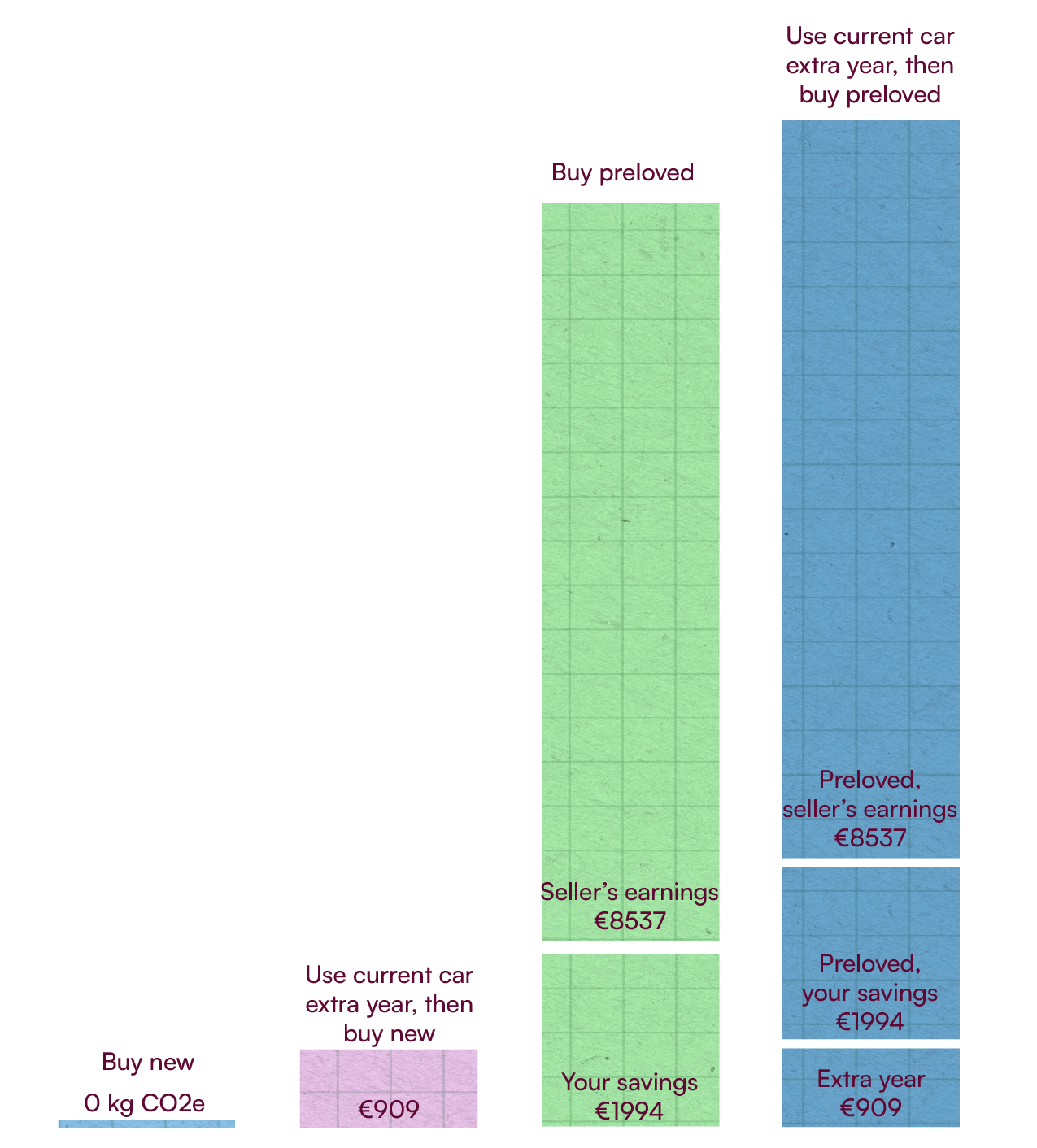
As you see, you save money (compared to buying a new product) and you help the seller earn some money (the price you pay them). Double win!
Prevented impact for this category is calculated using ‘the probability of alternative scenarios’, which includes the option of buying a new vehicle, buying another second-hand vehicle and buying no vehicle at all (methodology B). The use phase is included, since the impact of driving a (older) second-hand vehicle is higher compared to driving a new vehicle.
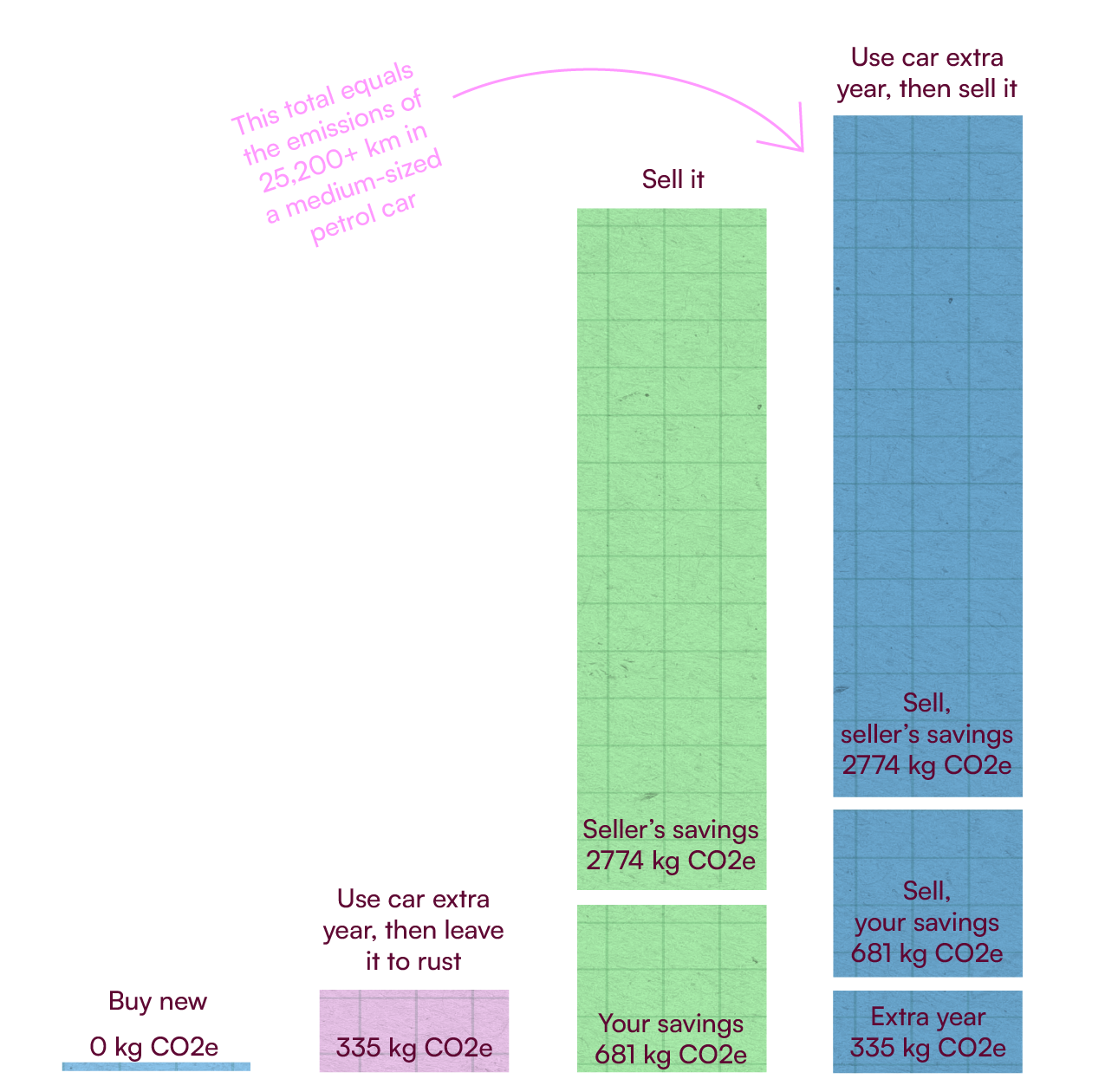
Please bear in mind that the graph above doesn’t show the use phase of a car, but it’s very important. Depending on the car age and distances you drive, it is possible that buying a preloved car is actually worse for the environment than buying a brand new one. Read more about the mechanisms behind this in the drop-down below.
The entire lifecycle impact of a car includes its production, its transportation to the user, waste treatment at its end-of-life and – very importantly – its use.
When you buy a preloved car, you reduce the demand for (and production, transport and waste treatment of) new cars by a bit: your positive impact. However, driving a preloved car also means driving a car that’s years or even decades old, and is thus more polluting in its use than a new car: your negative impact. If you buy a very old car and you drive a lot, it’s possible that the negative impact outweighs the positive impact.
As you can see in the graph, seller and buyer together save almost 3,500 kg CO2e when trading a preloved car: the positive impact. On average a car traded on OLX is over 13 years old and emits 0.2091 kg CO2eq per kilometer. The average buyer drives a total of 37,172 kilometers with their purchase, leading to total emissions of 7,800 kg CO2e, while a new car would emit only 6,000 kg CO2e over the same distance. Thus the negative impact is 1,800 kg CO2e. Conclusion: it’s still good for the planet to buy preloved, since your positive impact is larger than you negative.
But, if you drive 90,000 km with the car, the difference in the use phase (negative impact) between new and preloved grows to 4,200 kg CO2e. The negative impact now outweighs the positive impact, and it would’ve been better to retire this 13-year old car. The picture changes again if it concerns a younger, less polluting car. If the car is 10-12 years, the difference in the use phase between new and preloved when driving 90,000 km is only 2,500 kg CO2e. Then the positive impact outweighs the negative impact again.
Conclusion? It’s better for the planet not to buy and drive very old cars. It’s also better to drive less. If you drive a lot, buy a less polluting car.
Your first thought might be: for every preloved car traded, the sale (and thus production) of one new car is prevented (and thus its impact is prevented).
But it’s not the case that if you don’t buy a new car on OLX you would buy a new one instead. You might buy a new one instead, but you might also buy another preloved car or none at all. So it’s not true that for every preloved sale, a new car is prevented from being produced.
Therefore, we use a method called ‘probability of alternative scenarios’. We assume – based on desk research – that the chance of someone buying a new car is 50%, another preloved car 50% and no car at all 0%. The we apply these percentages to the entire lifecycle impact of a car.
Then there’s another factor that needs to be considered. A car has more users than just the first seller and buyer. On average, a car trades hands 4 times. On average, the first user sells at 50.4% of the lifespan of the car. The second after another 12.4%, the third after another 12.4%, and so on. That means that together, the first user (seller) and second user (buyer) save 50.4 plus 12.4% = 62.8% of the total lifecycle impact of a car. Not the entire lifecycle impact.
You could argue that buyer and seller both enable a trade, so the impact savings can be attributed to them 50/50. However, we think a better approach is to allocate the impact savings based on duration of use. On average, the first user, uses a car for 13.3 years, the second user for 3.5 years. Since we see it as a positive thing to use an item for as long as possible, we use the time that either of the users owned the item, to allocate the impact savings. Between them two, the first user (seller) used the item for 80% of the time and the second (buyer) for 20% of the time. So we allocate the impact savings (discussed in the previous drop-down) to them with an 80:20 ratio.
With every extra year you use an item, you postpone the purchase (and thus the demand for, and thus the production of) a new item. If the technical lifespan of an item is 27 years and you use your current car for another year, then technically, you save 1/27th part of the impact of a new product.
So, you want a new motorcycle without going bankrupt or frying the planet. Let us tell you what your options are and what your personal impact is, compared to buying new.
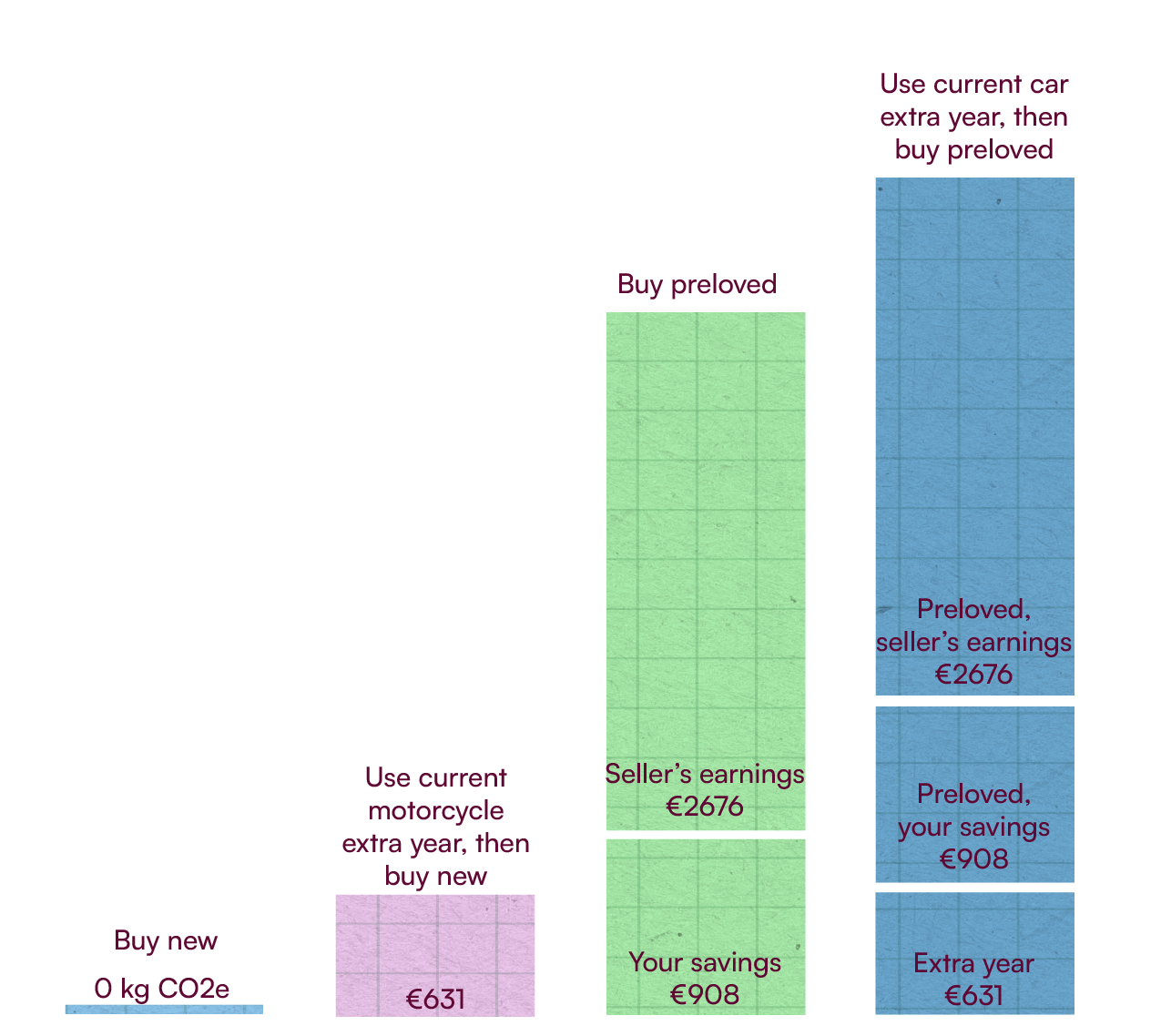
As you see, you save money (compared to buying a new product) and you help the seller earn some money (the price you pay them). Double win!
Prevented impact for this motorcycles is calculated using ‘the probability of alternative scenarios’, which includes the option of buying a new vehicle, buying another second-hand vehicle and buying no vehicle at all. The use phase is included, since the impact of driving a (older) second-hand vehicles is higher compared to driving a new vehicle.
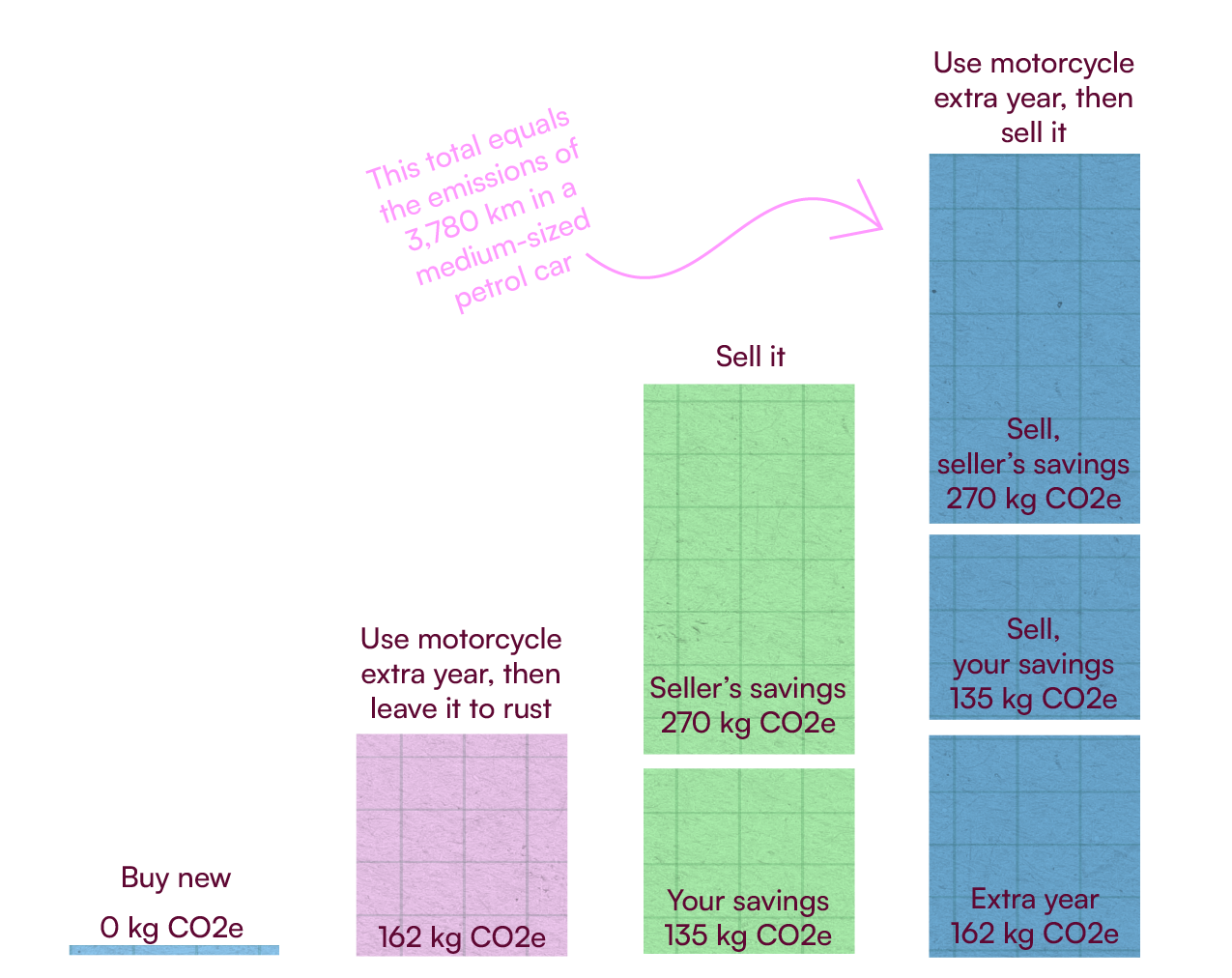
As you see, part of the impact savings are attributed to you as a buyer, but the seller also saves some. So combined, you and the seller make a great positive impact! (We show the seller and buyer savings separately, to avoid the risk of double counting, where both the seller and the buyer assume they saved the total amount.)
The entire lifecycle impact of a motorcycle includes its production, its transportation to the user, waste treatment at its end-of-life and – very importantly – its use.
When you buy a preloved motorcycle, you reduce the demand for (and production, transport and waste treatment of) new motorcycles by a bit: your positive impact. However, driving a preloved motorcycle also means driving a motorcycle that’s years or even decades old, and is thus more polluting in its use than a new motorcycle: your negative impact.
If you buy a very old motorcycle and you drive a lot, it’s possible that the negative impact outweighs the positive impact.
As you can see in the graph above, seller and buyer together save over 400 kg CO2e when trading a preloved motorcycle: the positive impact. Let’s assume you buy a 10-year-old motorcycle that emits 0.1135 kg CO2 per kilometer. The average buyer drives a total of 16,250 kilometers with their purchase, leading to total emissions of 1,845 kg CO2e, while a new motorcycle would emit only 1,640 kg CO2e over the same distance. Thus the negative impact is 205 kg CO2e. Conclusion: it’s still good for the planet to buy preloved, as your positive impact is larger than you negative.
But, if you drive 18,000 km with the motorcycle, the difference in the use phase (negative impact) between new and preloved grows to 460 kg CO2e. The negative impact now outweighs the positive impact, and it would’ve been better to not buy this 10-year-old motorcycle. The picture changes again if it concerns a younger, less polluting motorcycle. If the motorcycle is 5 years old, the difference in the use phase between new and preloved when driving 18,000 km is only 225 kg CO2e. Then the positive impact outweighs the negative impact again.
Conclusion? It’s better for the planet not to buy and drive very old motorcycles. It’s also better to drive less. If you drive a lot, buy a less polluting motorcycle.
Your first thought might be: for every preloved motorcycle traded, the sale (and thus production) of one new motorcycle is prevented (and thus its impact is prevented).
But it’s not the case that if you don’t buy a new motorcycle on OLX you would buy a new one instead. You might buy a new one instead, but you might also buy another preloved motorcycle or none at all. So it’s not true that for every preloved sale, a new motorcycle is prevented from being produced.
Therefore, we use a method called ‘probability of alternative scenarios’. We assume – based on desk research – that the chance of someone buying a new motorcycle is 50%, another preloved motorcycle 50% and no motorcycle at all 0%. The we apply these percentages to the entire lifecycle impact of a motorcycle.
Then there’s another factor that needs to be considered. A motorcycle has more users than just the first seller and buyer. On average, a motorcycle trades hands 2 times. On average, the first user sells at 50% of the lifespan of the car. The second after another 25% and the third after another 25%. That means that together, the first user (seller) and second user (buyer) save 50 plus 25% = 75% of the total lifecycle impact of a car. Not the entire lifecycle impact.
You could argue that buyer and seller both enable a trade, so the impact savings can be attributed to them 50/50. However, we think a better approach is to allocate the impact savings based on duration of use. On average, the first user, uses a motorcycle for 5 years, the second user for 2.5 years. Since we see it as a positive thing to use an item for as long as possible, we use the time that either of the users owned the item, to allocate the impact savings. Between them two, the first user (seller) used the item for 67% of the time and the second (buyer) for 33% of the time. So we allocate the impact savings (discussed in the previous drop-down) to them with an 67:33 ratio.
With every extra year you use an item, you postpone the purchase (and thus the demand for, and thus the production of) a new item. If the technical lifespan of an item is 11 years and you use your current motorcycle for another year, then technically, you save 1/11th part of the impact of a new product.
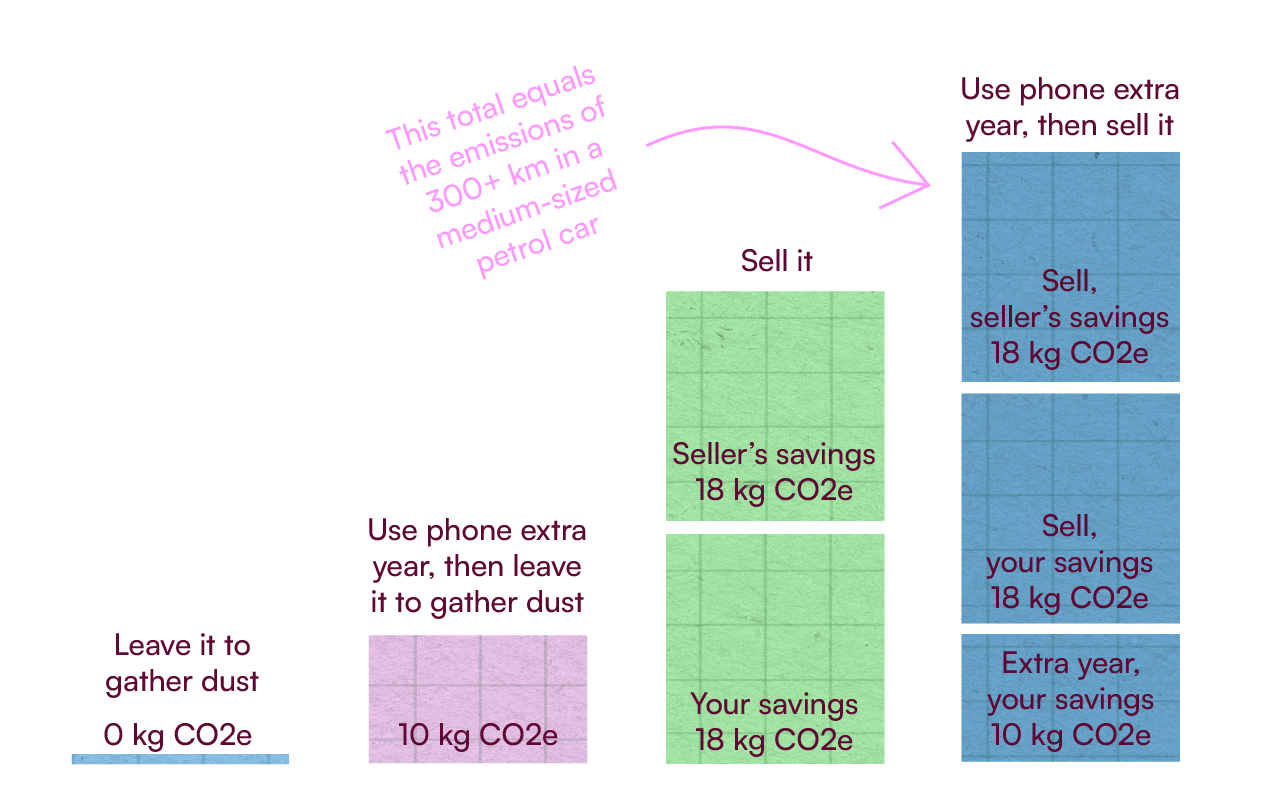
So, you have an old or broken phone. You could leave it in your drawer to gather dust, but that doesn't help anyone. There are way better options, for both your pockets and the planet. Yes, even if the phone doesn't work anymore!
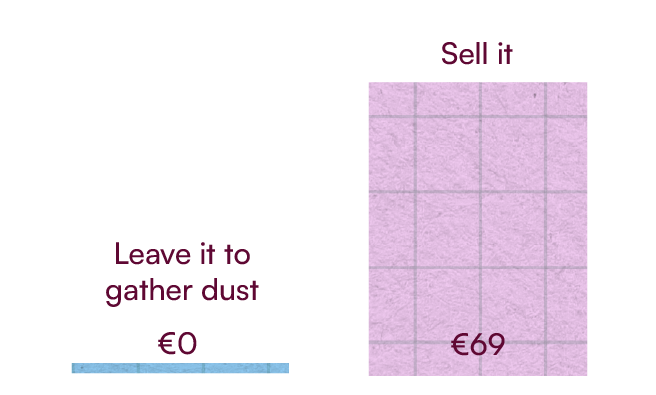
As you see, you save money (compared to buying a new product) and you help the seller earn some money. Double win!
The prevented impact of second hand electronics is calculated using the lifespan extension method. This means that we don’t assume that every second hand item traded means 1 less new items needs to be produced (because that’s not a conservative assumption), but we assume that the lifespan of the product is extended for a while (that’s more conservative). Put differently, only a fraction of the impact of a new item is prevented, not the entire impact.
The impact of the so-called use phase is not included, since we assume that electricity consumption associated with using a second hand device is equal to that of new ones. When a phone is still good, we assume that second hand trade extends its lifespan by 82%. This number is based on actual OLX trade data and [xxx]
Old or broken devices are often bought by refurbishers or people who disassemble them for their parts. Valuable parts and materials are then reused, and that way, new materials don’t have to be extracted from the earth or produced in factories. Or, to put it differently: a percentage of the production impact of a device is prevented.
When a phone is old or broken, we assume that 15% of the production impact is prevented. That’s because 60% of the environmental impact of electronics originates from the printed wiring board, of which 50% is recyclable and can be recovered with a yield of 50%. 60% * 50% * 50% = 15%.
Your phone is still good, but you want to get rid of it? We understand, but... changing your mind is the absolute best thing you can do for your pockets and planet. If we can't convince you to use it for another year, then let us convince you to sell it, so someone else can use it for some more time.
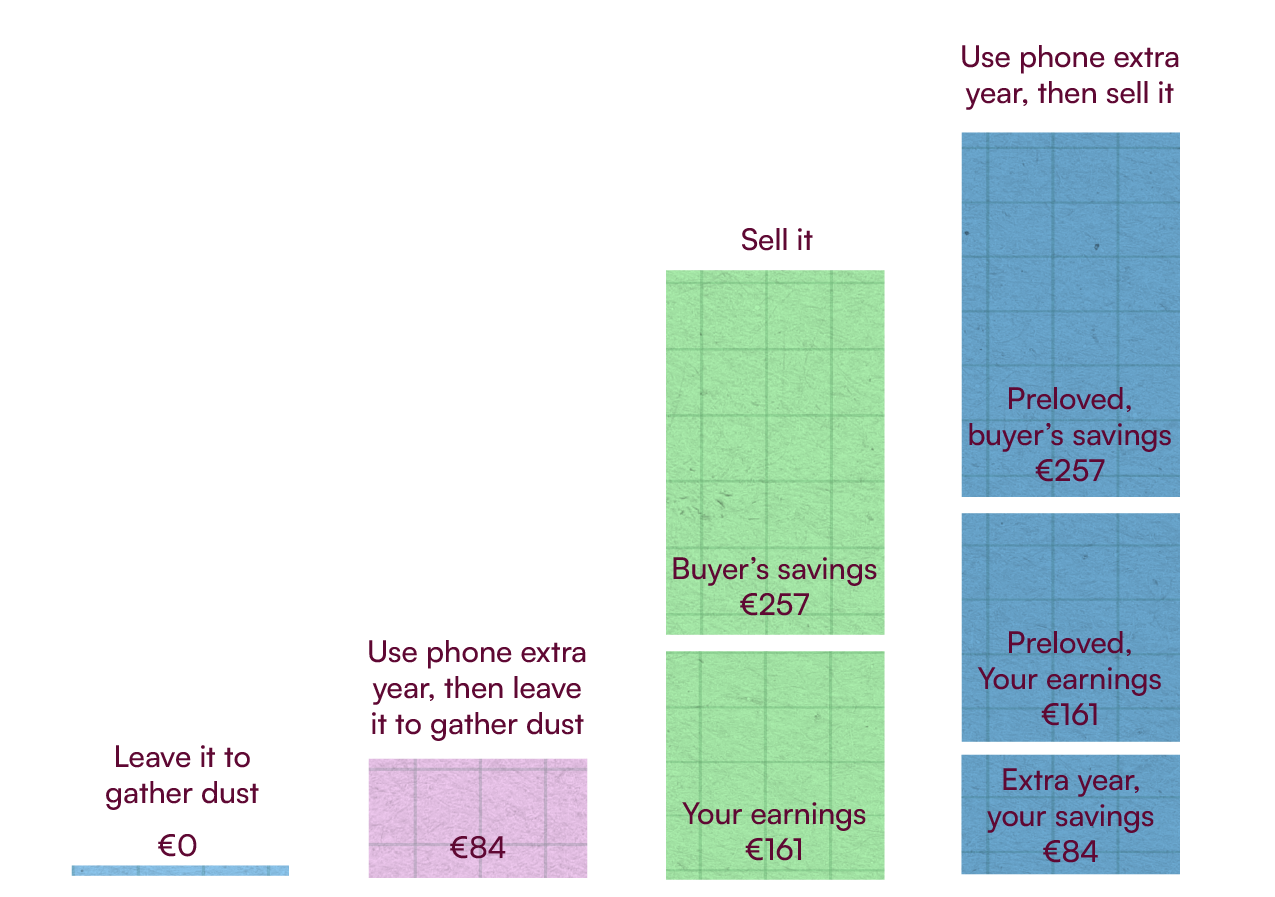
As you see, the best thing you
The prevented impact of second hand electronics is calculated using the lifespan extension method. This means that we don’t assume that every second hand item traded means 1 less new items needs to be produced (because that’s not a conservative assumption), but we assume that the lifespan of the product is extended for a while (that’s more conservative). Put differently, only a fraction of the impact of a new item is prevented, not the entire impact.
The impact of the so-called use phase is not included, since we assume that electricity consumption associated with using a second hand device is equal to that of new ones. When a phone is still good, we assume that second hand trade extends its lifespan by 82%. This number is based on actual OLX trade data and [xxx]
The prevented impact of second hand electronics is calculated using the lifespan extension method. This means that we don’t assume that every second hand item traded means 1 less new items needs to be produced (because that’s not a conservative assumption), but we assume that the lifespan of the product is extended for a while (that’s more conservative). Put differently, only a fraction of the impact of a new item is prevented, not the entire impact.
The impact of the so-called use phase is not included, since we assume that electricity consumption associated with using a second hand device is equal to that of new ones. When a phone is still good, we assume that second hand trade extends its lifespan by 82%. This number is based on actual OLX trade data and [xxx]
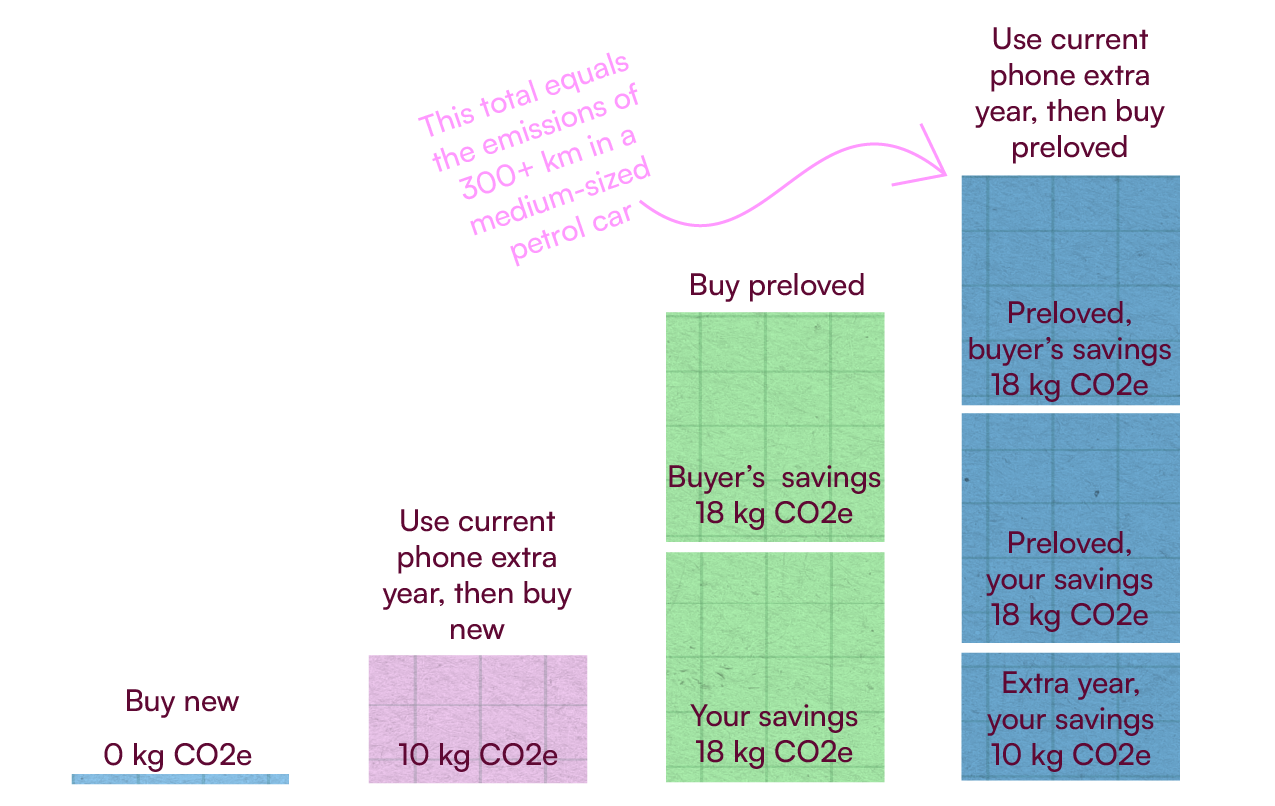
As you see, part of the impact savings are attributed to you as a buyer, but the seller also saves some. So combined, you and the seller make a great positive impact!
First, we calculated the impact of producing a phone, from ‘cradle to grave’: from resources all the way to waste treatment.
The prevented impact of preloved electronics is then calculated using the lifespan extension method: we don’t assume that every preloved item traded prevents 1 new item of being produced, transported and disposed of (because that’s not a conservative assumption). Rather, we assume that the production of a new item is postponed by a few years. This way, a certain percentage of the lifecycle impact of a new item is prevented, not the entire impact.
For example, a 4-year-old smartphone is sold. The buyer uses it for another 2 years. Then 50% was added to the initial lifespan, and 50% of its impact was ‘saved’: 2 divided by 4.
We know the technical lifespan of devices, and we also know at what age they’re sold on average on OLX. So we also know the extended lifespan: when a phone is still good, we assume that trade extends its lifespan by 64%. Of course, we don’t know the exact phone model and age you aim to sell. The numbers you see here are for the average smartphone traded on OLX between ’21 and ‘24.
The impact of the so-called use phase is not included, since we assume that electricity consumption associated with using a preloved device is equal to that of new ones.
You could argue that buyer and seller both enable a trade, so the impact savings can be attributed to them 50/50. However, we think a better approach is to allocate the impact savings based on duration of use. So if the first user sells the phone after 2 years and the buyer uses it for another 4 years, then we assign 2/6th part (33%) of the impact savings to the seller and 4/6th (67%) to the buyer.
With every extra year you use an item, you postpone the purchase (and thus the demand for, and thus the production of) a new item. If the technical lifespan of an item is 6 years and you use your current device for another year, then technically, you save 1/6th part of the impact of a new product.
So, you have an old or broken tablet. You could leave it in your drawer to gather dust, but that doesn't help anyone. There are way better options, for both your pockets and the planet. Yes, even if the phone doesn't work anymore!
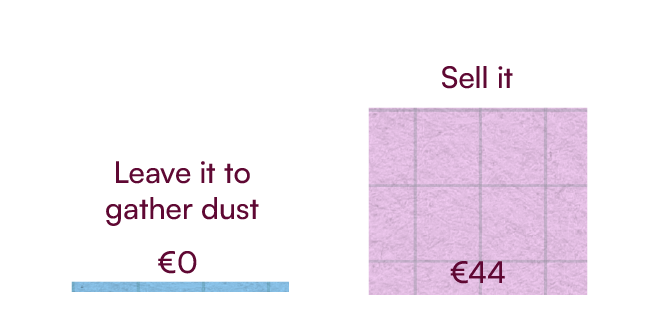
As you see, you save money (compared to buying a new product) and you help the seller earn some money. Double win!
The prevented impact of second hand electronics is calculated using the lifespan extension method. This means that we don’t assume that every second hand item traded means 1 less new items needs to be produced (because that’s not a conservative assumption), but we assume that the lifespan of the product is extended for a while (that’s more conservative). Put differently, only a fraction of the impact of a new item is prevented, not the entire impact.
The impact of the so-called use phase is not included, since we assume that electricity consumption associated with using a second hand device is equal to that of new ones. When a phone is still good, we assume that second hand trade extends its lifespan by 82%. This number is based on actual OLX trade data and [xxx]
Old or broken devices are often bought by refurbishers or people who disassemble them for their parts. Valuable parts and materials are then reused, and that way, new materials don’t have to be extracted from the earth or produced in factories. Or, to put it differently: a percentage of the production impact of a device is prevented.
When a phone is old or broken, we assume that 15% of the production impact is prevented. That’s because 60% of the environmental impact of electronics originates from the printed wiring board, of which 50% is recyclable and can be recovered with a yield of 50%. 60% * 50% * 50% = 15%.
Your tablet is still good, but you want to get rid of it? We understand, but... changing your mind is the absolute best thing you can do for your pockets and planet. If we can't convince you to use it for another year, then let us convince you to sell it, so someone else can use it for some more time.
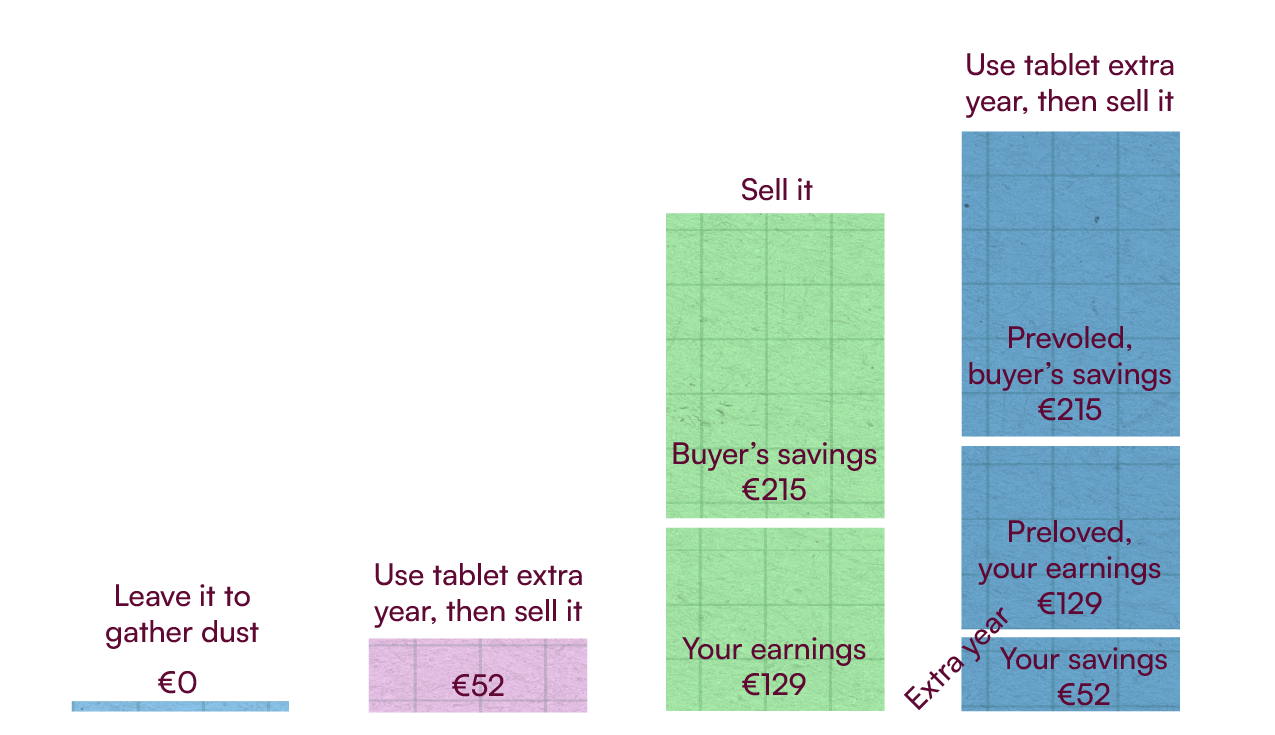
As you see, the best thing you
The prevented impact of second hand electronics is calculated using the lifespan extension method. This means that we don’t assume that every second hand item traded means 1 less new items needs to be produced (because that’s not a conservative assumption), but we assume that the lifespan of the product is extended for a while (that’s more conservative). Put differently, only a fraction of the impact of a new item is prevented, not the entire impact.
The impact of the so-called use phase is not included, since we assume that electricity consumption associated with using a second hand device is equal to that of new ones. When a phone is still good, we assume that second hand trade extends its lifespan by 82%. This number is based on actual OLX trade data and [xxx]
Old or broken devices are often bought by refurbishers or people who disassemble them for their parts. Valuable parts and materials are then reused, and that way, new materials don’t have to be extracted from the earth or produced in factories. Or, to put it differently: a percentage of the production impact of a device is prevented.
When a phone is old or broken, we assume that 15% of the production impact is prevented. That’s because 60% of the environmental impact of electronics originates from the printed wiring board, of which 50% is recyclable and can be recovered with a yield of 50%. 60% * 50% * 50% = 15%.
As you see, part of the impact savings are attributed to you as a buyer, but the seller also saves some. So combined, you and the seller make a great positive impact!
First, we calculated the impact of producing a tablet, from ‘cradle to grave’: from resources all the way to waste treatment.
The prevented impact of preloved electronics is then calculated using the lifespan extension method: we don’t assume that every preloved item traded prevents 1 new item of being produced, transported and disposed of (because that’s not a conservative assumption). Rather, we assume that the production of a new item is postponed by a few years. This way, a certain percentage of the lifecycle impact of a new item is prevented, not the entire impact.
For example, a 4-year-old tablet is sold. The buyer uses it for another 2 years. Then 50% was added to the initial lifespan, and 50% of its impact was ‘saved’: 2 divided by 4.
We know the technical lifespan of devices, and we also know at what age they’re sold on average on OLX. So we also know the extended lifespan: when a tablet is still good, we assume that trade extends its lifespan by 75%. Of course, we don’t know the exact tablet model and age you aim to sell. The numbers you see here are for the average tablet traded on OLX between ’21 and ‘24.
The impact of the so-called use phase is not included, since we assume that electricity consumption associated with using a preloved device is equal to that of new ones.
You could argue that buyer and seller both enable a trade, so the impact savings can be attributed to them 50/50. However, we think a better approach is to allocate the impact savings based on duration of use. So if the first user sells the tablet after 2 years and the buyer uses it for another 3 years, then we assign 2/5th part (33%) of the impact savings to the seller and 4/5th (67%) to the buyer.
With every extra year you use an item, you postpone the purchase (and thus the demand for, and thus the production of) a new item. If the technical lifespan of an item is 6 years and you use your current device for another year, then technically, you save 1/6th part of the impact of a new product.
So, you have an old or broken laptop. You could leave it in your drawer to gather dust, but that doesn't help anyone. There are way better options, for both your pockets and the planet. Yes, even if the phone doesn't work anymore!
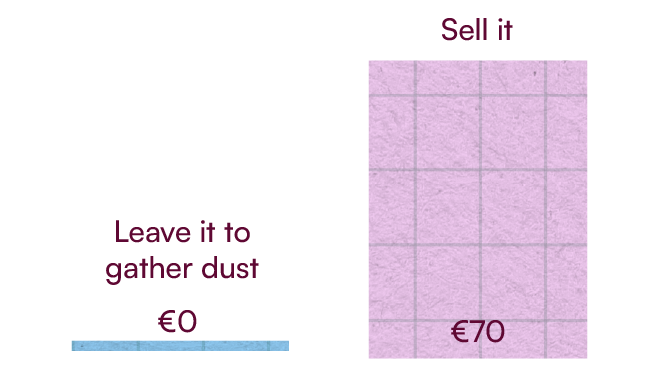
As you see, you save money (compared to buying a new product) and you help the seller earn some money. Double win!
The prevented impact of second hand electronics is calculated using the lifespan extension method. This means that we don’t assume that every second hand item traded means 1 less new items needs to be produced (because that’s not a conservative assumption), but we assume that the lifespan of the product is extended for a while (that’s more conservative). Put differently, only a fraction of the impact of a new item is prevented, not the entire impact.
The impact of the so-called use phase is not included, since we assume that electricity consumption associated with using a second hand device is equal to that of new ones. When a phone is still good, we assume that second hand trade extends its lifespan by 82%. This number is based on actual OLX trade data and [xxx]
Old or broken devices are often bought by refurbishers or people who disassemble them for their parts. Valuable parts and materials are then reused, and that way, new materials don’t have to be extracted from the earth or produced in factories. Or, to put it differently: a percentage of the production impact of a device is prevented.
When a phone is old or broken, we assume that 15% of the production impact is prevented. That’s because 60% of the environmental impact of electronics originates from the printed wiring board, of which 50% is recyclable and can be recovered with a yield of 50%. 60% * 50% * 50% = 15%.
Your laptop is still good, but you want to get rid of it? We understand, but... changing your mind is the absolute best thing you can do for your pockets and planet. If we can't convince you to use it for another year, then let us convince you to sell it, so someone else can use it for some more time.
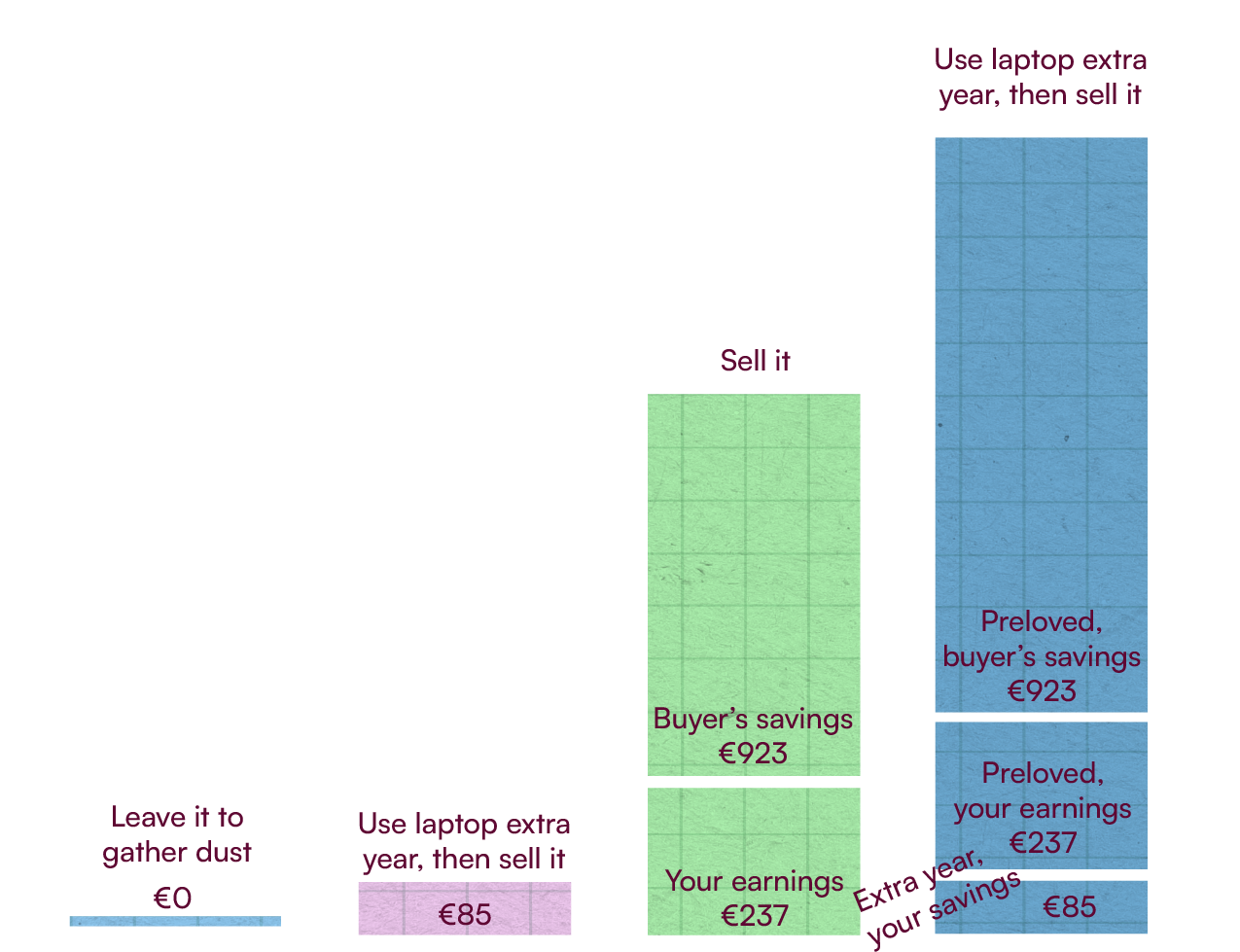
As you see, the best thing you
The prevented impact of second hand electronics is calculated using the lifespan extension method. This means that we don’t assume that every second hand item traded means 1 less new items needs to be produced (because that’s not a conservative assumption), but we assume that the lifespan of the product is extended for a while (that’s more conservative). Put differently, only a fraction of the impact of a new item is prevented, not the entire impact.
The impact of the so-called use phase is not included, since we assume that electricity consumption associated with using a second hand device is equal to that of new ones. When a phone is still good, we assume that second hand trade extends its lifespan by 82%. This number is based on actual OLX trade data and [xxx]
Old or broken devices are often bought by refurbishers or people who disassemble them for their parts. Valuable parts and materials are then reused, and that way, new materials don’t have to be extracted from the earth or produced in factories. Or, to put it differently: a percentage of the production impact of a device is prevented.
When a phone is old or broken, we assume that 15% of the production impact is prevented. That’s because 60% of the environmental impact of electronics originates from the printed wiring board, of which 50% is recyclable and can be recovered with a yield of 50%. 60% * 50% * 50% = 15%.
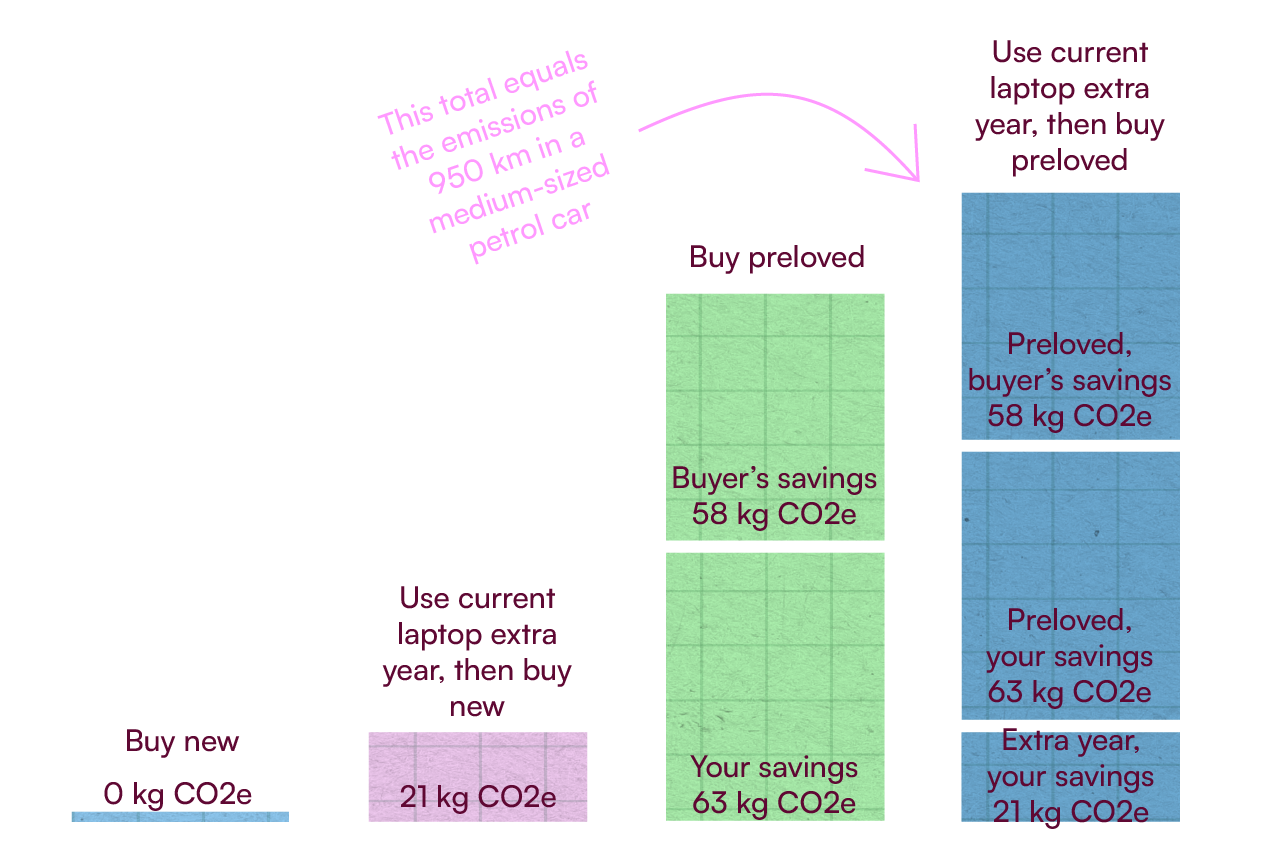
As you see, part of the impact savings are attributed to you as a buyer, but the seller also saves some. So combined, you and the seller make a great positive impact!
First, we calculated the impact of producing a laptop, from ‘cradle to grave’: from resources all the way to waste treatment.
The prevented impact of preloved electronics is then calculated using the lifespan extension method: we don’t assume that every preloved item traded prevents 1 new item of being produced, transported and disposed of (because that’s not a conservative assumption). Rather, we assume that the production of a new item is postponed by a few years. This way, a certain percentage of the lifecycle impact of a new item is prevented, not the entire impact.
For example, a 4-year-old laptop is sold. The buyer uses it for another 3 years. Then 75% was added to the initial lifespan, and 75% of its impact was ‘saved’: 3 divided by 4.
We know the technical lifespan of devices, and we also know at what age they’re sold on average on OLX. So we also know the extended lifespan: when a laptop is still good, we assume that trade extends its lifespan by 92%. Of course, we don’t know the exact laptop model and age you aim to sell. The numbers you see here are for the average laptop traded on OLX between ’21 and ‘24.
The impact of the so-called use phase is not included, since we assume that electricity consumption associated with using a preloved device is equal to that of new ones.
You could argue that buyer and seller both enable a trade, so the impact savings can be attributed to them 50/50. However, we think a better approach is to allocate the impact savings based on duration of use. So if the first user sells the laptop after 2 years and the buyer uses it for another 4 years, then we assign 2/6th part (33%) of the impact savings to the seller and 4/6th (67%) to the buyer.
With every extra year you use an item, you postpone the purchase (and thus the demand for, and thus the production of) a new item. If the technical lifespan of an item is 6 years and you use your current device for another year, then technically, you save 1/6th part of the impact of a new product.
So, you have an old or broken TV. You could leave it in your drawer to gather dust, but that doesn't help anyone. There are way better options, for both your pockets and the planet. Yes, even if the phone doesn't work anymore!
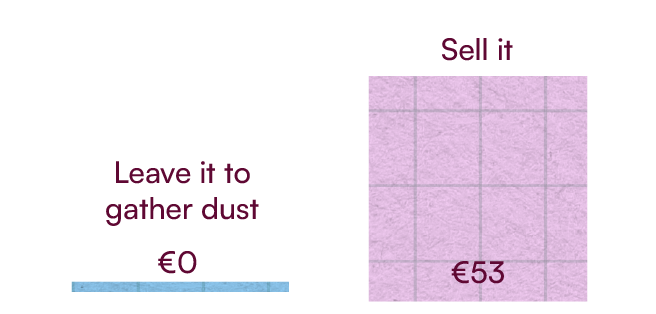
As you see, you save money (compared to buying a new product) and you help the seller earn some money. Double win!
The prevented impact of second hand electronics is calculated using the lifespan extension method. This means that we don’t assume that every second hand item traded means 1 less new items needs to be produced (because that’s not a conservative assumption), but we assume that the lifespan of the product is extended for a while (that’s more conservative). Put differently, only a fraction of the impact of a new item is prevented, not the entire impact.
The impact of the so-called use phase is not included, since we assume that electricity consumption associated with using a second hand device is equal to that of new ones. When a phone is still good, we assume that second hand trade extends its lifespan by 82%. This number is based on actual OLX trade data and [xxx]
Old or broken devices are often bought by refurbishers or people who disassemble them for their parts. Valuable parts and materials are then reused, and that way, new materials don’t have to be extracted from the earth or produced in factories. Or, to put it differently: a percentage of the production impact of a device is prevented.
When a phone is old or broken, we assume that 15% of the production impact is prevented. That’s because 60% of the environmental impact of electronics originates from the printed wiring board, of which 50% is recyclable and can be recovered with a yield of 50%. 60% * 50% * 50% = 15%.
Your TV is still good, but you want to get rid of it? We understand, but... changing your mind is the absolute best thing you can do for your pockets and planet. If we can't convince you to use it for another year, then let us convince you to sell it, so someone else can use it for some more time.
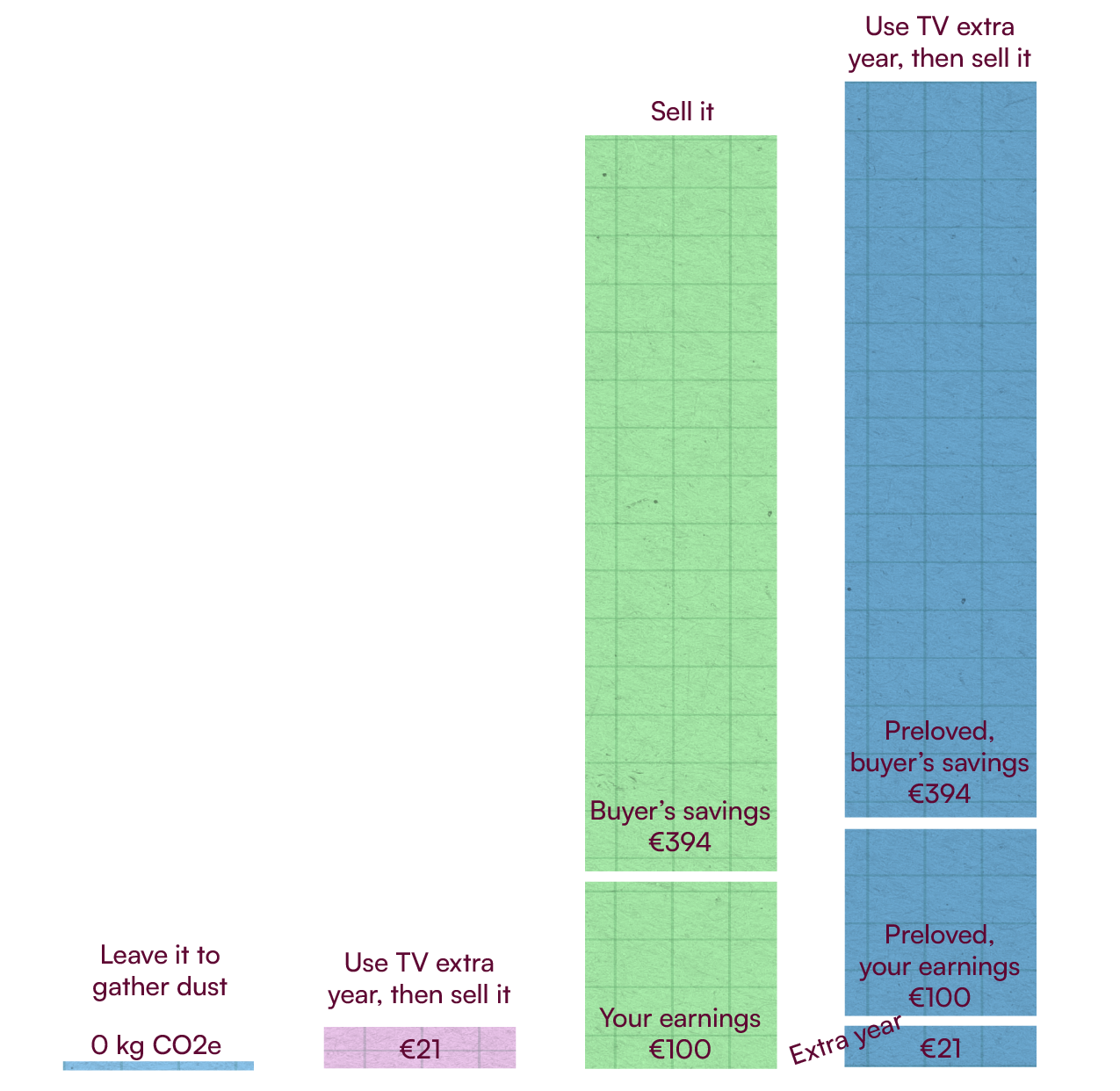
As you see, the best thing you
The prevented impact of second hand electronics is calculated using the lifespan extension method. This means that we don’t assume that every second hand item traded means 1 less new items needs to be produced (because that’s not a conservative assumption), but we assume that the lifespan of the product is extended for a while (that’s more conservative). Put differently, only a fraction of the impact of a new item is prevented, not the entire impact.
The impact of the so-called use phase is not included, since we assume that electricity consumption associated with using a second hand device is equal to that of new ones. When a phone is still good, we assume that second hand trade extends its lifespan by 82%. This number is based on actual OLX trade data and [xxx]
Old or broken devices are often bought by refurbishers or people who disassemble them for their parts. Valuable parts and materials are then reused, and that way, new materials don’t have to be extracted from the earth or produced in factories. Or, to put it differently: a percentage of the production impact of a device is prevented.
When a phone is old or broken, we assume that 15% of the production impact is prevented. That’s because 60% of the environmental impact of electronics originates from the printed wiring board, of which 50% is recyclable and can be recovered with a yield of 50%. 60% * 50% * 50% = 15%.
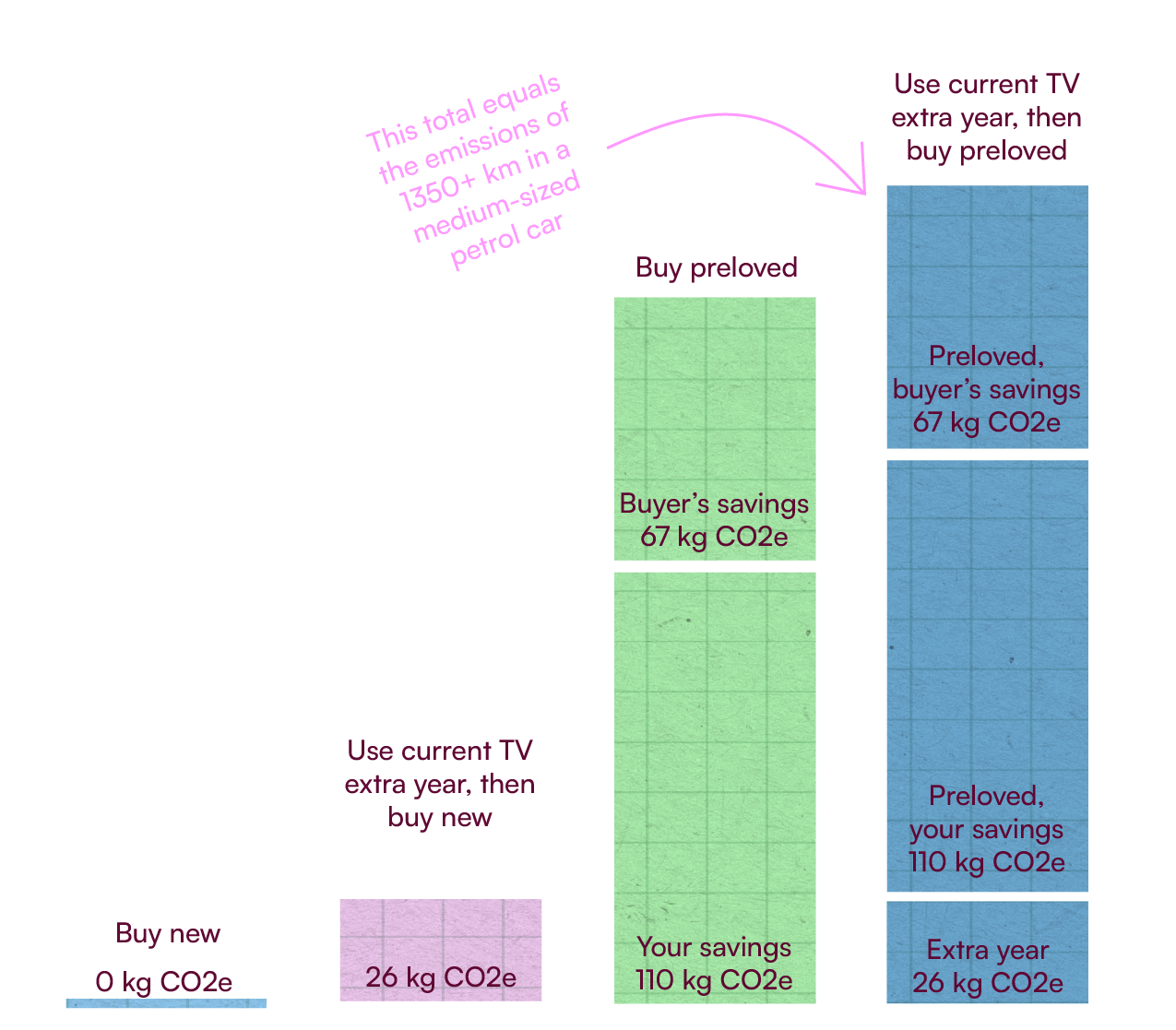
As you see, part of the impact savings are attributed to you as a buyer, but the seller also saves some. So combined, you and the seller make a great positive impact!
First, we calculated the impact of producing a laptop, from ‘cradle to grave’: from resources all the way to waste treatment.
The prevented impact of preloved electronics is then calculated using the lifespan extension method: we don’t assume that every preloved item traded prevents 1 new item of being produced, transported and disposed of (because that’s not a conservative assumption). Rather, we assume that the production of a new item is postponed by a few years. This way, a certain percentage of the lifecycle impact of a new item is prevented, not the entire impact.
For example, a 4-year-old laptop is sold. The buyer uses it for another 3 years. Then 75% was added to the initial lifespan, and 75% of its impact was ‘saved’: 3 divided by 4.
We know the technical lifespan of devices, and we also know at what age they’re sold on average on OLX. So we also know the extended lifespan: when a laptop is still good, we assume that trade extends its lifespan by 92%. Of course, we don’t know the exact laptop model and age you aim to sell. The numbers you see here are for the average laptop traded on OLX between ’21 and ‘24.
The impact of the so-called use phase is not included, since we assume that electricity consumption associated with using a preloved device is equal to that of new ones.
You could argue that buyer and seller both enable a trade, so the impact savings can be attributed to them 50/50. However, we think a better approach is to allocate the impact savings based on duration of use. So if the first user sells the laptop after 2 years and the buyer uses it for another 4 years, then we assign 2/6th part (33%) of the impact savings to the seller and 4/6th (67%) to the buyer.
With every extra year you use an item, you postpone the purchase (and thus the demand for, and thus the production of) a new item. If the technical lifespan of an item is 6 years and you use your current device for another year, then technically, you save 1/6th part of the impact of a new product.
So, you have an old or broken car. You could leave it in your drawer to gather dust, but that doesn't help anyone. There are way better options, for both your pockets and the planet. Yes, even if the phone doesn't work anymore!
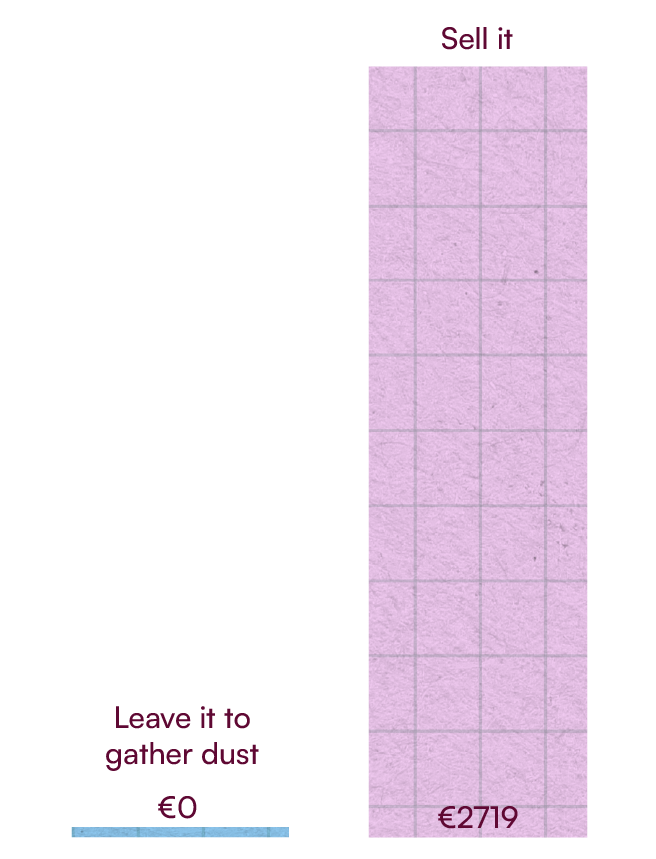
As you see, you save money (compared to buying a new product) and you help the seller earn some money. Double win!
The prevented impact of second hand electronics is calculated using the lifespan extension method. This means that we don’t assume that every second hand item traded means 1 less new items needs to be produced (because that’s not a conservative assumption), but we assume that the lifespan of the product is extended for a while (that’s more conservative). Put differently, only a fraction of the impact of a new item is prevented, not the entire impact.
The impact of the so-called use phase is not included, since we assume that electricity consumption associated with using a second hand device is equal to that of new ones. When a phone is still good, we assume that second hand trade extends its lifespan by 82%. This number is based on actual OLX trade data and [xxx]
Old or broken devices are often bought by refurbishers or people who disassemble them for their parts. Valuable parts and materials are then reused, and that way, new materials don’t have to be extracted from the earth or produced in factories. Or, to put it differently: a percentage of the production impact of a device is prevented.
When a phone is old or broken, we assume that 15% of the production impact is prevented. That’s because 60% of the environmental impact of electronics originates from the printed wiring board, of which 50% is recyclable and can be recovered with a yield of 50%. 60% * 50% * 50% = 15%.
Your car is still good, but you want to get rid of it? We understand, but... changing your mind is the absolute best thing you can do for your pockets and planet. If we can't convince you to use it for another year, then let us convince you to sell it, so someone else can use it for some more time.
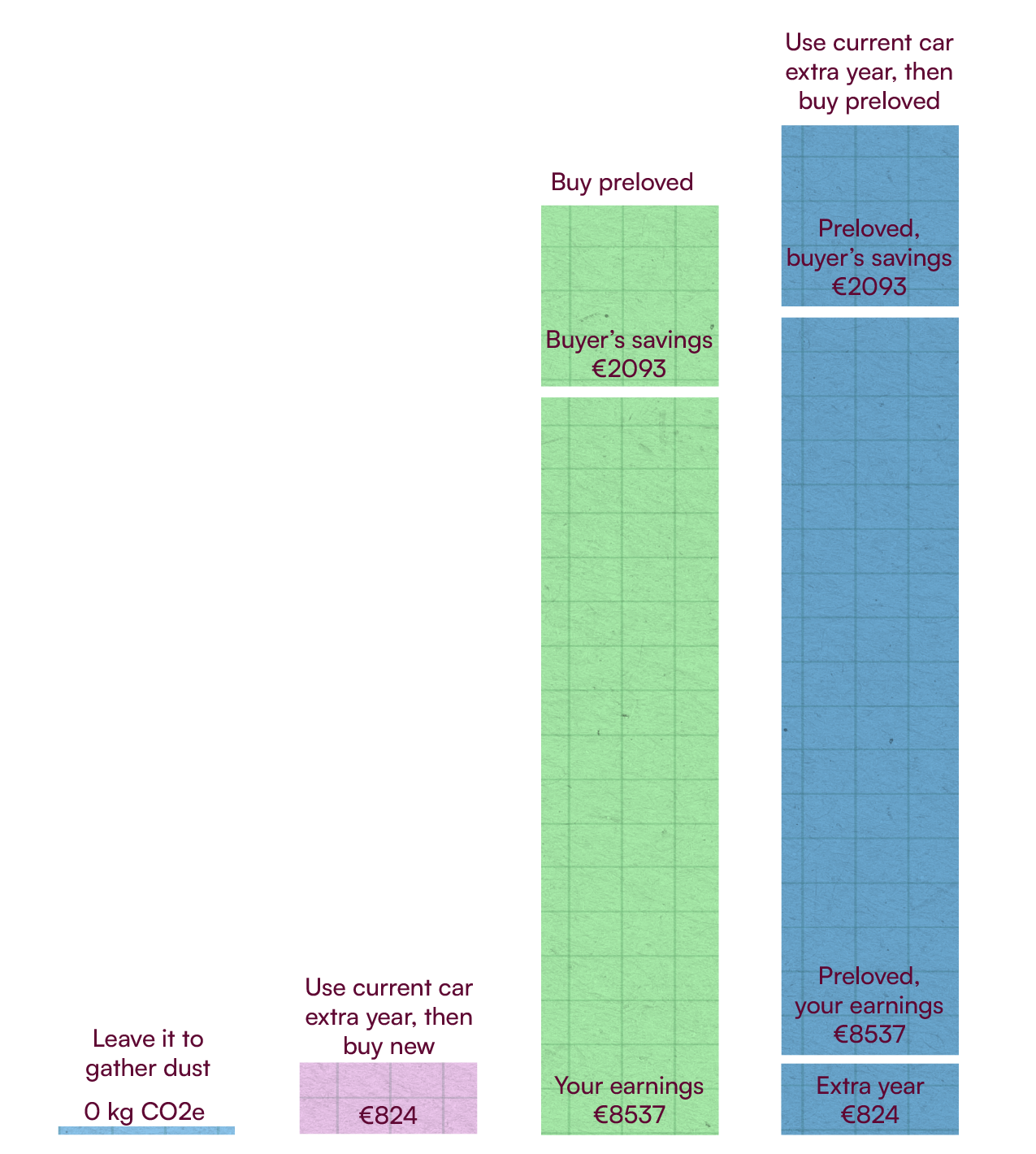
As you see, the best thing you
The prevented impact of second hand electronics is calculated using the lifespan extension method. This means that we don’t assume that every second hand item traded means 1 less new items needs to be produced (because that’s not a conservative assumption), but we assume that the lifespan of the product is extended for a while (that’s more conservative). Put differently, only a fraction of the impact of a new item is prevented, not the entire impact.
The impact of the so-called use phase is not included, since we assume that electricity consumption associated with using a second hand device is equal to that of new ones. When a phone is still good, we assume that second hand trade extends its lifespan by 82%. This number is based on actual OLX trade data and [xxx]
Old or broken devices are often bought by refurbishers or people who disassemble them for their parts. Valuable parts and materials are then reused, and that way, new materials don’t have to be extracted from the earth or produced in factories. Or, to put it differently: a percentage of the production impact of a device is prevented.
When a phone is old or broken, we assume that 15% of the production impact is prevented. That’s because 60% of the environmental impact of electronics originates from the printed wiring board, of which 50% is recyclable and can be recovered with a yield of 50%. 60% * 50% * 50% = 15%.
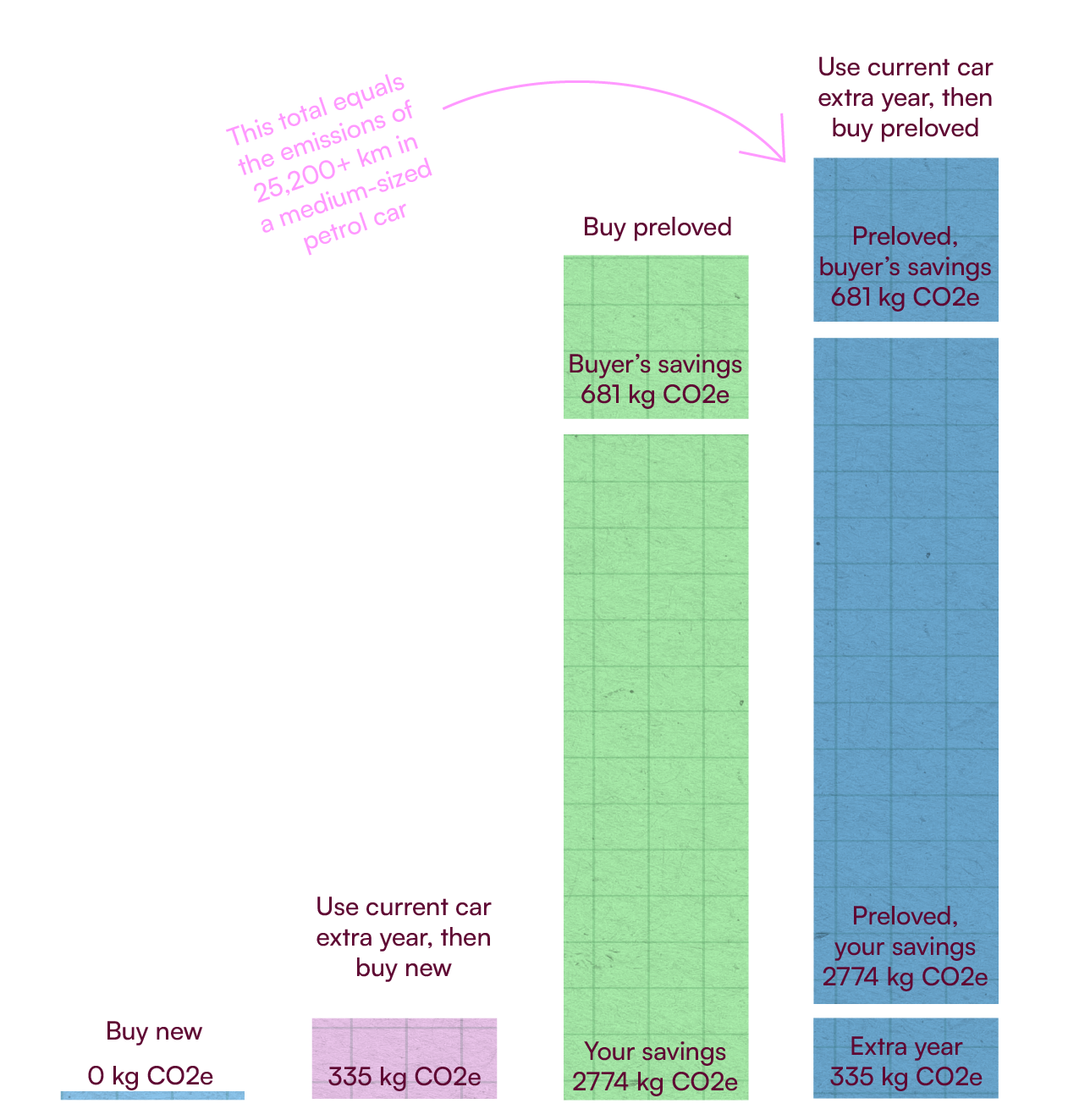
Please bear in mind that the graph above doesn’t show the use phase of a car, but it’s very important. Depending on the car age and distances driven, it is possible that selling a car is actually worse for the environment than taking it off the road. Read more about the mechanisms behind this in the drop-down below.
The entire lifecycle impact of a car includes its production, its transportation to the user, waste treatment at its end-of-life and – very importantly – its use.
When you sell your car, you reduce the demand for (and production, transport and waste treatment of) new cars by a bit: your positive impact. However, selling a car also means you keep a car on the road that’s years or even decades old, and is thus more polluting in its use than a new car: your negative impact.
If you sell a very old car and the buyer drives a lot, it’s possible that the negative impact (by keeping the car on the road) outweighs the positive impact (of saving part of a car’s lifecycle impact).
As you can see in the graph above, seller and buyer together save almost 3,500 kg CO2e when trading a preloved car: the positive impact. On average a car traded on OLX is over 13 years old and emits 0.2091 kg CO2eq per kilometer. The average buyer drives a total of 37,172 kilometers with their purchase, leading to total emissions of 7,800 kg CO2e, while a new car would emit only 6,000 kg CO2e over the same distance. Thus the negative impact is 1,800 kg CO2e. Conclusion: it’s still good for the planet to keep this car in the loop, as your positive impact is larger than you negative.
But, if the buyer drives 90,000 km with the car, the difference in the use phase (negative impact) between new and preloved grows to 4,200. The negative impact now outweighs the positive impact, and it would’ve been better to retire this 13-year old car. The picture changes again if it concerns a younger, less polluting car. If the car is 10-12 years, the difference in the use phase between new and preloved when driving 90,000 km is only 2,500. Then the positive impact outweighs the negative impact again.
Conclusion? It’s better for the planet to take very old cars off the road. And it’s better for the planet to drive less. If you drive a lot, buy a less polluting car.
Your first thought might be: for every preloved car traded, the sale (and thus production) of a new car is prevented (and thus its impact is prevented).
But it’s not the case that if you don’t sell your car on OLX the buyer that would’ve bought your car, will buy a new one instead. They might buy a new one instead, but they might also buy another preloved car or none at all. So it’s not true that for every preloved sale, a new car is prevented from being produced.
Also, if you don’t sell your car on OLX, you won’t just leave it to rust away or bring it to the scrap yard. You will just sell it somewhere else, right? So in any case, it won’t go to waste.
Therefore, we use a method called ‘probability of alternative scenarios’. We assume – based on desk research – that the chance of someone buying a new car is 50%, another preloved car 50% and no car at all 0%. The we apply these percentages to the entire lifecycle impact of a car.
Then there’s another factor that needs to be considered. A car has more users than just the first seller and buyer. On average, a car trades hand 4 times. On average, the first user sells at 50.4% of the lifespan of the car. The second after another 12.4%, the thirds after another 12.4%, and so on. That means that together, the first seller and buyer save 50.4 plus 12.4% = 62.8% of the total lifecycle impact of a car. Not the entire lifecycle impact.
You could argue that buyer and seller both enable a trade, so the impact savings can be attributed to them 50/50. However, we think a better approach is to allocate the impact savings based on duration of use. On average, the first user, uses a car for 13.3 years, the second user for 3.5 years. Since we see it as a positive thing to use an item for as long as possible, we use the time that either of the users owned the item, to allocate the impact savings. Between them two, the first user (seller) used the item for 80% of the time and the second (buyer) for 20% of the time. So we allocate the impact savings (discussed in the previous drop-down) to them with an 80:20 ratio.
With every extra year you use an item, you postpone the purchase (and thus the demand for, and thus the production of) a new item. If the technical lifespan of an item is 27 years and you use your current car for another year, then technically, you save 1/27th part of the impact of a new product.
So, you have an old or broken motorcycle. You could leave it in your drawer to gather dust, but that doesn't help anyone. There are way better options, for both your pockets and the planet. Yes, even if the phone doesn't work anymore!
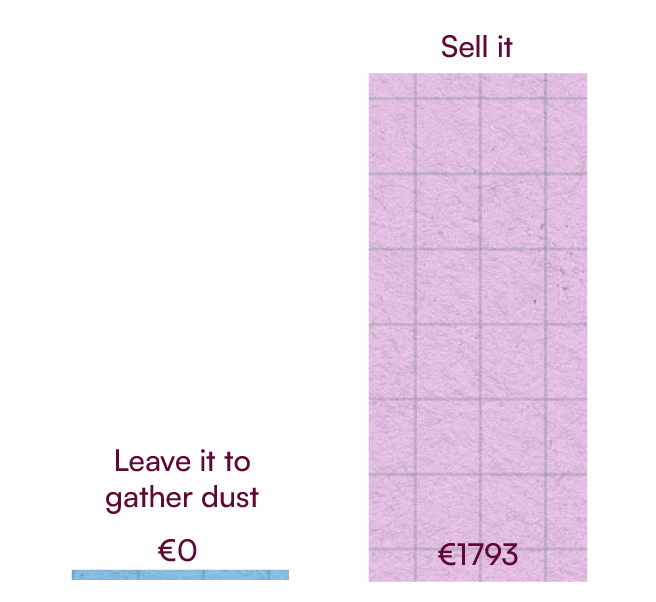
As you see, you save money (compared to buying a new product) and you help the seller earn some money. Double win!
The prevented impact of second hand electronics is calculated using the lifespan extension method. This means that we don’t assume that every second hand item traded means 1 less new items needs to be produced (because that’s not a conservative assumption), but we assume that the lifespan of the product is extended for a while (that’s more conservative). Put differently, only a fraction of the impact of a new item is prevented, not the entire impact.
The impact of the so-called use phase is not included, since we assume that electricity consumption associated with using a second hand device is equal to that of new ones. When a phone is still good, we assume that second hand trade extends its lifespan by 82%. This number is based on actual OLX trade data and [xxx]
Old or broken devices are often bought by refurbishers or people who disassemble them for their parts. Valuable parts and materials are then reused, and that way, new materials don’t have to be extracted from the earth or produced in factories. Or, to put it differently: a percentage of the production impact of a device is prevented.
When a phone is old or broken, we assume that 15% of the production impact is prevented. That’s because 60% of the environmental impact of electronics originates from the printed wiring board, of which 50% is recyclable and can be recovered with a yield of 50%. 60% * 50% * 50% = 15%.
Your motorcycle is still good, but you want to get rid of it? We understand, but... changing your mind is the absolute best thing you can do for your pockets and planet. If we can't convince you to use it for another year, then let us convince you to sell it, so someone else can use it for some more time.
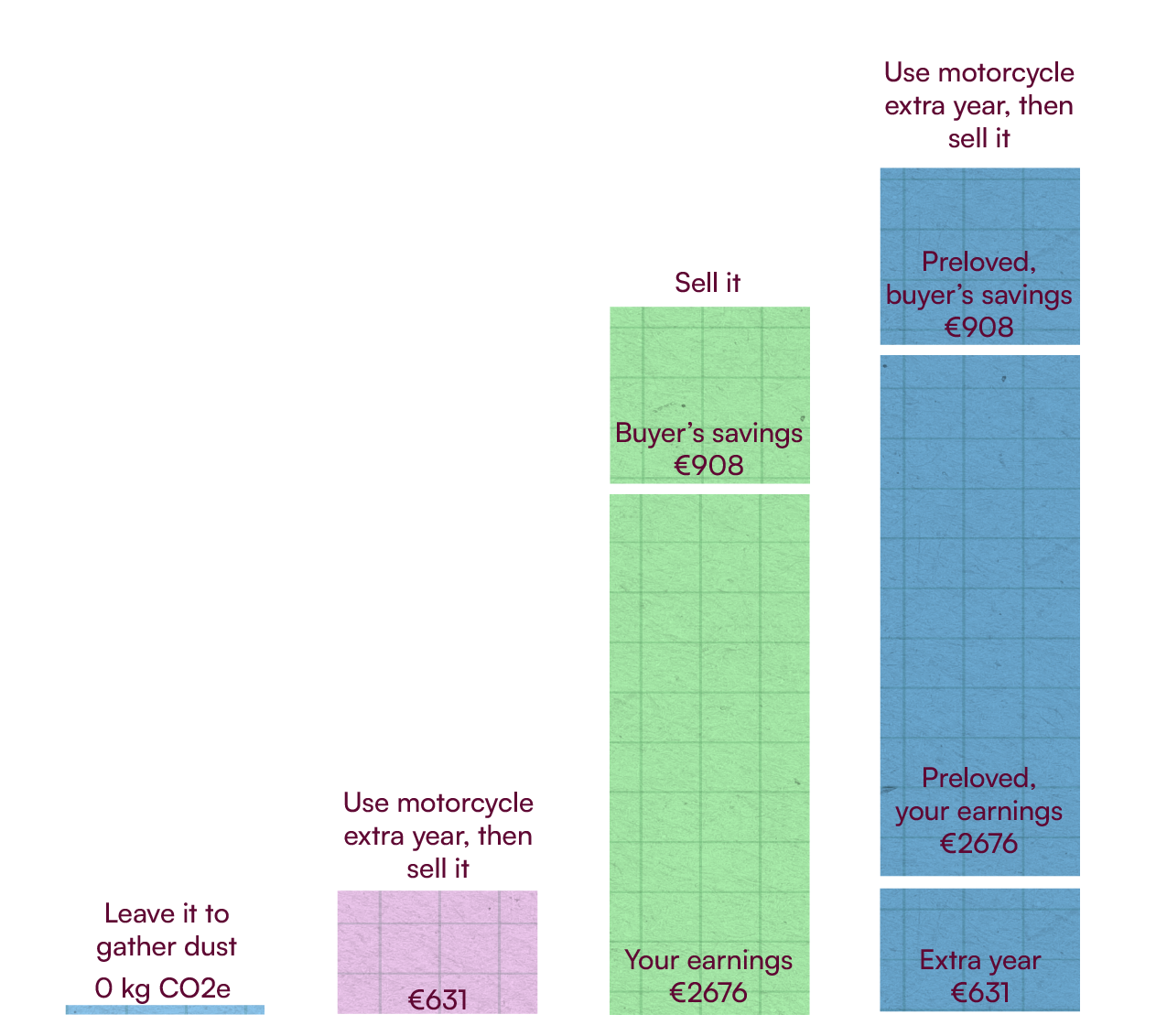
As you see, the best thing you
The prevented impact of second hand electronics is calculated using the lifespan extension method. This means that we don’t assume that every second hand item traded means 1 less new items needs to be produced (because that’s not a conservative assumption), but we assume that the lifespan of the product is extended for a while (that’s more conservative). Put differently, only a fraction of the impact of a new item is prevented, not the entire impact.
The impact of the so-called use phase is not included, since we assume that electricity consumption associated with using a second hand device is equal to that of new ones. When a phone is still good, we assume that second hand trade extends its lifespan by 82%. This number is based on actual OLX trade data and [xxx]
Old or broken devices are often bought by refurbishers or people who disassemble them for their parts. Valuable parts and materials are then reused, and that way, new materials don’t have to be extracted from the earth or produced in factories. Or, to put it differently: a percentage of the production impact of a device is prevented.
When a phone is old or broken, we assume that 15% of the production impact is prevented. That’s because 60% of the environmental impact of electronics originates from the printed wiring board, of which 50% is recyclable and can be recovered with a yield of 50%. 60% * 50% * 50% = 15%.
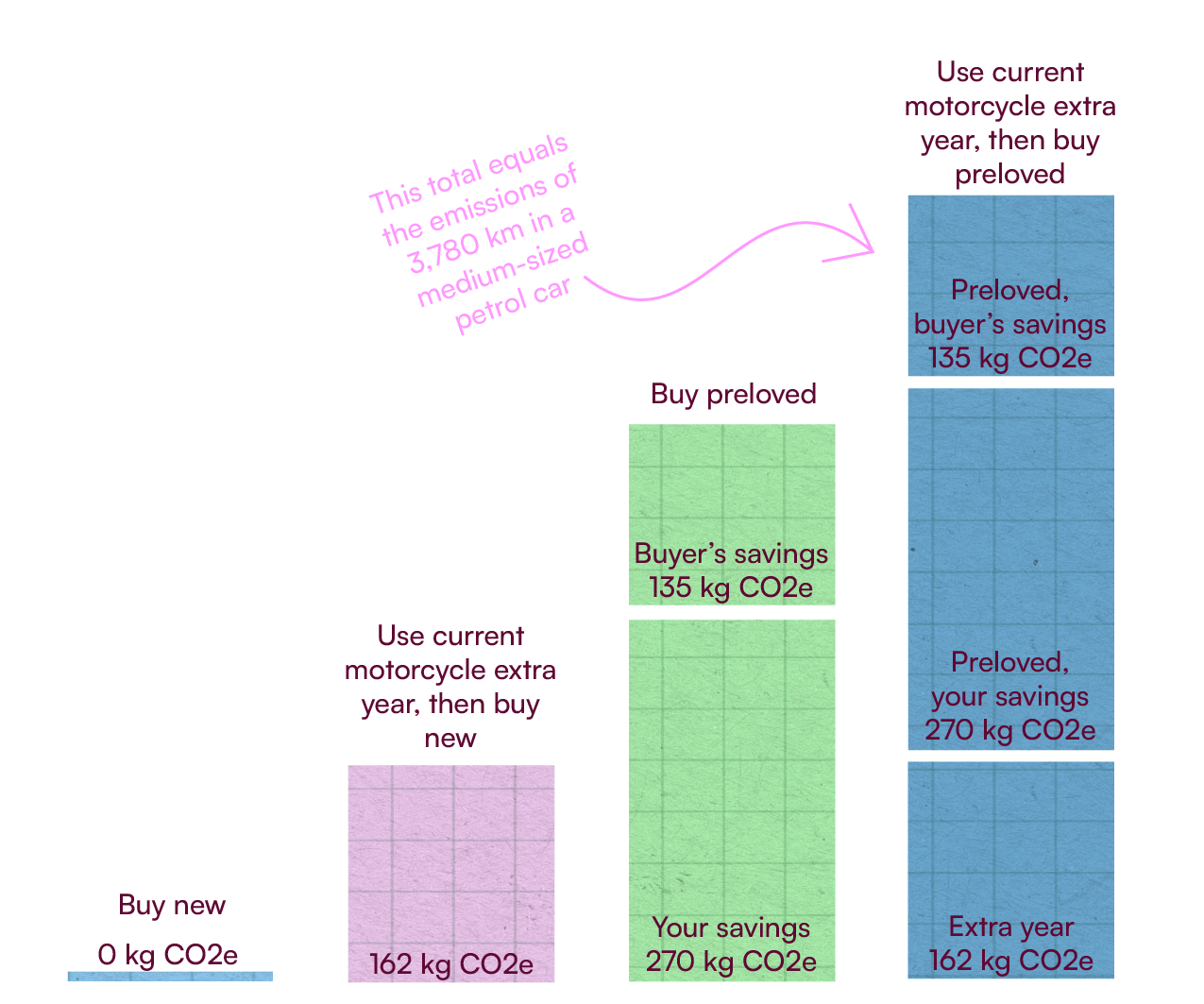
Please bear in mind that the graph above doesn’t show the use phase of a motorcycle, but it’s very important. Depending on the motorcycle age and distances driven, it is possible that selling a motorcycle is actually worse for the environment than taking it off the road. Read more about the mechanisms behind this in the drop-down below.
The entire lifecycle impact of a motorcycle includes its production, its transportation to the user, waste treatment at its end-of-life and – very importantly – its use.
When you sell your motorcycle, you reduce the demand for (and production, transport and waste treatment of) new motorcycles by a bit: your positive impact. However, selling a motorcycle also means you keep a motorcycle on the road that’s years or even decades old, and is thus more polluting in its use than a new motorcycle: your negative impact.
If you sell a very old motorcycle and the buyer drives a lot, it’s possible that the negative impact (by keeping the motorcycle on the road) outweighs the positive impact (of saving part of a motorcycle’s lifecycle impact).
As you can see in the graph above, seller and buyer together save over 400 kg CO2e when trading a preloved motorcycle: the positive impact. Let’s assume you sell a 10-year-old motorcycle that emits 0.1135 kg CO2 per kilometer. The average buyer drives a total of 16,250 kilometers with their purchase, leading to total emissions of 1,845 kg CO2e, while a new motorcycle would emit only 1,640 kg CO2e over the same distance. Thus the negative impact is 205 kg CO2e. Conclusion: it’s still good for the planet to keep this motorcycle in the loop, as your positive impact (400) is larger than your negative (205).
But, if the buyer drives 18,000 km with the motorcycle, the difference in the use phase (negative impact) between new and preloved grows to 460 kg CO2e. The negative impact (460) now outweighs the positive impact (400), and it would’ve been better to retire this 10-year old motorcycle. The picture changes again if it concerns a younger, less polluting motorcycle. If the motorcycle is 5 years old, the difference in the use phase between new and preloved when driving 18,000 km is only 225 kg CO2e. Then the positive impact outweighs the negative impact again.
Conclusion? It’s better for the planet to take very old motorcycles off the road. And it’s better for the planet to drive less. If you drive a lot, buy a less polluting motorcycle.
Your first thought might be: for every preloved motorcycle traded, the sale (and thus production) of a new motorcycle is prevented (and thus its impact is prevented).
But it’s not the case that if you don’t sell your motorcycle on OLX the buyer that would’ve bought your motorcycle, will buy a new one instead. They might buy a new one instead, but they might also buy another preloved motorcycle or none at all. So it’s not true that for every preloved sale, a new car is prevented from being produced.
Also, if you don’t sell your motorcycle on OLX, you won’t just leave it to rust away or bring it to the scrap yard. You will just sell it somewhere else, right? So in any case, it won’t go to waste.
Therefore, we use a method called ‘probability of alternative scenarios’. We assume – based on desk research – that the chance of someone buying a new motorcycle is 50%, another preloved motorcycle 50% and no motorcycle at all 0%. The we apply these percentages to the entire lifecycle impact of a motorcycle.
Then there’s another factor that needs to be considered. A car has more users than just the first seller and buyer. On average, a car trades hand 4 times. On average, the first user sells at 50.4% of the lifespan of the car. The second after another 12.4%, the thirds after another 12.4%, and so on. That means that together, the first seller and buyer save 50.4 plus 12.4% = 62.8% of the total lifecycle impact of a car. Not the entire lifecycle impact.
You could argue that buyer and seller both enable a trade, so the impact savings can be attributed to them 50/50. However, we think a better approach is to allocate the impact savings based on duration of use. On average, the first user, uses a motorcycle for 5 years, the second user for 2.5 years. Since we see it as a positive thing to use an item for as long as possible, we use the time that either of the users owned the item, to allocate the impact savings. Between them two, the first user (seller) used the item for 67% of the time and the second (buyer) for 33% of the time. So we allocate the impact savings (discussed in the previous drop-down) to them with an 67:33 ratio.
With every extra year you use an item, you postpone the purchase (and thus the demand for, and thus the production of) a new item. If the technical lifespan of an item is 10 years and you use your current motorcycle for another year, then technically, you save 1/10th part of the impact of a new product.

.png)
.png)
.png)