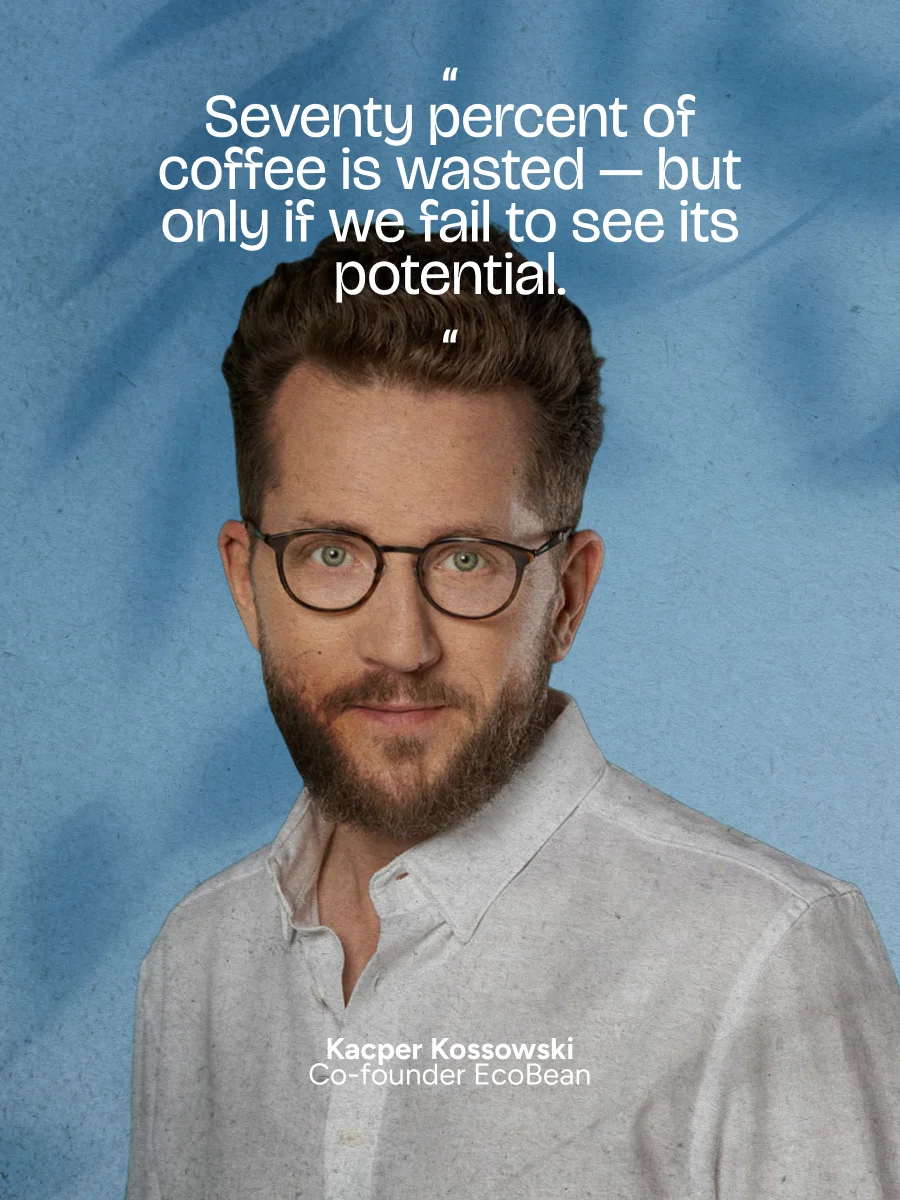
Kacper Kossowski spent twenty years in the coffee industry, running a roastery and supplying cafés across Poland. Over time, he noticed something troubling: most of the value in a coffee cherry never made it to the cup. Less than 5% was used, the rest discarded.
When his first company was acquired, he stayed on as CEO – a comfortable, secure position – yet he couldn't let go of the idea to give coffee a second life. Leaving that golden cage behind, he started EcoBean from scratch. Today, the company transforms spent coffee grounds into sustainable ingredients for food, cosmetics, and beyond, showing that waste only becomes waste when we fail to see its potential.
Kacper grew up in Warsaw, Poland, where he studied economics and M&A — a sensible plan that didn’t last very long. Curious about building things himself, he soon launched a fast-casual Chinese to-go concept, getting an early (and honest) taste of entrepreneurship from the ground up.
Coffee came next. As Poland’s specialty coffee scene started to take off, Kacper co-founded Coffee Zone, a consultancy and barista-training company that grew into one of the country’s leading roasteries. It was later acquired by an international player, and he stayed on for five years to help steer the next chapter.
But here’s where it got interesting: instead of just thinking about the first life of coffee, he started wondering about its second. That curiosity led to the birth of EcoBean — a company focused on giving used coffee grounds a new purpose, turning waste into high-value, sustainable products on an industrial scale.
‘There wasn’t one big ‘aha’ moment. It was more like a slow, uncomfortable realisation. I spent 20 years working with coffee. Then one day I just stepped back and looked at the numbers: we use less than 5% of the coffee cherry. If you brew a cup of coffee, only about 30% of what’s valuable from the coffee actually ends up in your cup. Seventy percent is wasted.
At the same time, green coffee prices are at an all-time high and we keep treating it as if it’s unlimited. Most sustainability discussions in this industry were happening on the side of the farmers’ country of origin, which is important, but Europe consumes over 30% of the world’s coffee. We are also responsible. And we are creating massive waste on this end of the chain.
That was the turning point for me: realising that even after people enjoy their coffee, there is still enormous value left in it’
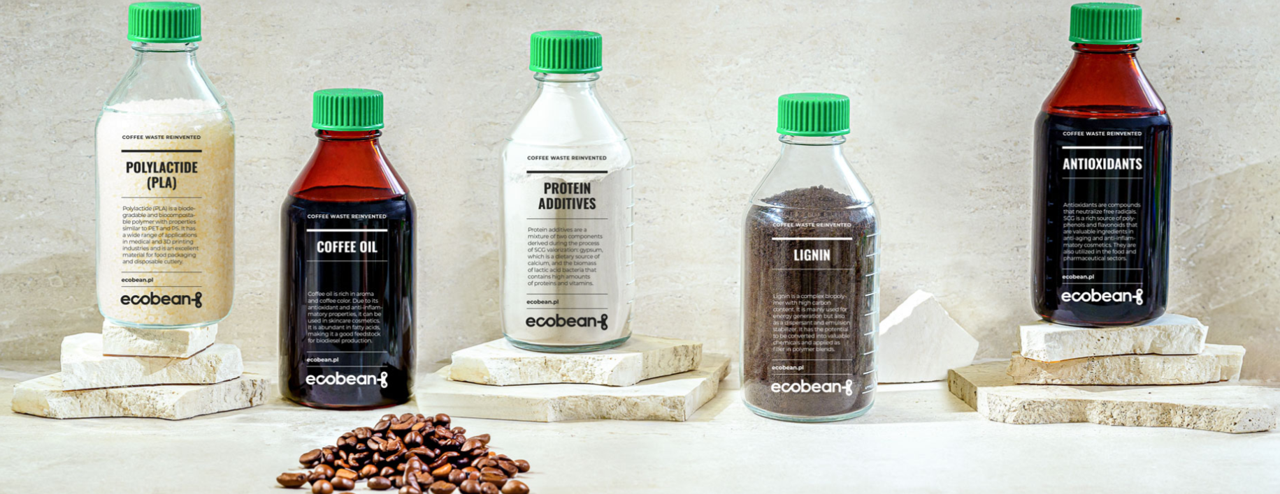
‘EcoBean is a technology company that transforms spent coffee grounds at scale into valuable sustainable ingredients. We can extract compounds like coffee oil, antioxidants, lignin and rare sugars that are used in cosmetics, food and beverages, nutraceuticals and even in the chemical and petrochemical industries. We’re not trying to create a new market, but rather to step into existing conventional ones with new sustainable alternatives.
The exciting part is that our technology is modular. Coffee waste is somewhat different depending on where it comes from: a café, a roastery, or an instant coffee factory. Even different countries produce different types of waste. So first, we analyse samples and then we design a custom solution. Based on the specific value of that waste, we can say: “You should focus on coffee oil,” or “In your case, antioxidants make most sense.” With this approach, we can offer tailored solutions to optimize both the process and yield.
That way, we can install processing platforms all over the world – in Brazil, Vietnam, India, Europe – wherever the waste is created.’
The average instant coffee plant generates approximately 20,000 tonnes of spent coffee grounds every year – in just one location. Worldwide, about 4.5 billion tonnes of coffee waste is created annually.
And what’s happening now? In many places, it’s simply burned. One tonne of spent coffee grounds gives you maybe €250 when it’s used as energy equivalent.
With our technology, that same tonne can generate up to €9,000 in value, with a 40–50% margin. And on top of that, we avoid around 2.6 tonnes of CO₂ emissions per tonne of coffee waste. That’s the difference between seeing waste or seeing a resource.’
‘Not in a romantic way. I never walked around saying ‘I want to save the world’. Circularity came into my life naturally through logic.
But something I have always believed in is this: sustainability must be based on a solid business case. Otherwise it will never scale. It will stay a nice idea for a small group of people.
With EcoBean, sustainability and economics go hand in hand. And that gives us a real chance to change the industry instead of just talking about it.’

‘In my previous business, we were one of the local market leaders. We worked closely with certifications and industry standards, and while those systems are important, they also showed me their limits. On paper, everything can look ‘sustainable’. In reality, most systems still function in straight lines: take, make, use, discard.
When we started EcoBean, a new idea began to take shape in my mind: what if there could one day be a circular coffee certificate? A system where a company that owns the farm, the brand and the retail – a company like Starbucks, for example – could guarantee that its coffee doesn’t end at the cup. That it comes back as something else: a cream, a shampoo, a supplement.
It’s still a big, audacious vision and we’re not there yet. But I truly believe that this level of responsibility will eventually become normal for large brands.
And on a personal level, startups changed me. They taught me resilience. You don’t learn that from certificates. You learn it from almost failing, standing back up, and continuing anyway.’
‘Letting go of safety, above all. When I stepped away from my CEO role after the company was sold, people were genuinely surprised. The business was doing well. From the outside, it didn’t make sense. But at some point you realise you can’t be fully present in too many dreams at once. To commit to one, you have to let the others go.
Starting EcoBean meant beginning from zero again: building a new team, convincing investors, living without a stable income, planning in six-month horizons instead of five-year strategies.
In the early days, I was everything at once: marketing, sales, partnerships, strategy. It was energising, but it was also heavy. I’m not made of teflon, it got to me. And I wasn’t 22 anymore. I was 42. Starting from scratch at that age hits differently. You have different responsibilities. In my case: a family to take care of.
At the same time, it brings incredible clarity. You stop chasing noise. You become very aware of what truly matters and what simply doesn’t.’
‘We once secured a grant of almost €7.5 million. For months, it felt like everything had suddenly accelerated, like the hard part was finally behind us. And then, because of political decisions completely outside our control, the money never arrived. It was a huge disappointment. And also a brutal but valuable lesson in not building your future on promises. Luckily, we didn’t and therefore survived.
Another one was our very first idea back in 2018: turning coffee waste into briquettes. At the time, it felt innovative. Now, I’m not particularly proud of it. The margins were low, and more importantly, it didn’t align with the kind of impact I truly wanted to have. Burning waste is still burning.
Then the pandemic hit and forced us to stop everything. In that pause, something shifted. We went back to the whiteboard and asked ourselves a much bigger question: if we’re going to do this, why not do it properly? Why not aim for something truly advanced, something that actually prevents CO₂ emissions instead of just managing waste?
That was the moment the real EcoBean was born: focused on sustainable ingredients, advanced technology, and real environmental value. And maybe that’s the biggest lesson of all: success is nice, but it’s the mistakes that really shape you. They force you to go deeper, think bigger, and get clearer about why you’re doing this in the first place.’
‘At home, circularity is just… normal. We separate waste without thinking about it. We choose organic products whenever we can – my wife even runs a company that sells them, so the bar is pretty high. If I show up with something wrapped in plastic, I know I’ll be hearing about it at dinner.
But we try not to live like environmental police. It’s not stressful. It’s just a conscious way of going through the day.
That said, I have three kids who seem to have a natural talent for leaving lights on in every room they enter. So clearly, I’m still losing some battles at home.’
‘I think coffee can become an example for every other industry. The moment we stop treating waste as something to burn or bury, and start seeing it as a circular asset, everything shifts. A hundred years ago, coffee was rare. Now it’s everywhere, and we still throw most of it away. That doesn’t make sense anymore, and people are starting to feel that, especially in Europe. This is no longer optional. The solutions already exist. Now it’s just a matter of making them standard, and making them scale.
The beautiful thing about coffee is that it’s universal. Almost everyone drinks it. Almost everyone has seen the waste left behind. It’s very visual. So when we explain that we take those spent coffee grounds and turn them into ingredients for hand cream or shampoo, there’s always that moment of: Wait… really? Even though we are backed by highly innovative technology, our ideas can still be explained in 30 seconds. It’s tangible, it’s real, and it changes the way people look at something they see – and throw away – every single day. And if that shift in perception happens, even just a little, then we’re already succeeding.’
Florine started out as an art critic, but that turned out to not be quite her thing. So, she did what any sensible person would do - packed her life (and family) into a tiny campervan and roamed the planet for seven years. Now back in the Netherlands, she’s juggling life as a strategic advisor for a Dutch non-profit, while also writing for magazines and platforms. When she’s not typing away, you’ll probably find her treasure-hunting at thrift stores to jazz up her tiny house by the sea. Or wandering outdoors, because apparently sitting still isn’t really her vibe.
Subscribe to the monthly mindshift
Our very best, every month in your mailbox. Subscribe now and join the reloved revolution!
Follow us on your favourite platform