I discovered that generative AI can bridge the imagination gap and show you what a piece could look like once repainted, reupholstered, reframed or styled in your own space. Here’s how.

Tips and lists
Buying second-hand furniture or art can be intimidating. For many of us – myself included – it’s difficult to imagine what a dated dresser or damaged chaise longue might look like once given new life. The best thrifters have the rare ability to see potential instantly. But if I think something is ugly at first glance, little can convince me to change my mind. And that’s where AI comes in.
I discovered that generative AI can bridge the imagination gap and show you what a piece could look like once repainted, reupholstered, reframed or styled in your own space. Here’s how.
Start with pictures of the furniture you’re considering: take a photo in the thrift store or download the pictures from the online marketplace you’re browsing.
As an example, I downloaded a picture of a second-hand bedroom set listed on OLX Poland for €900: a bed, wardrobe, chest of drawers, two small cabinets and a mirror. Honestly? I would never buy it like that, so I was curious to see if AI could change my mind.
Upload the photo into an image generator and tell it what you’d like to change. If you’re unsure, you can also ask the image generator to improve the furniture to ‘it’s own liking’. I used Gemini’s newly updated tool with this prompt:
“Please use this exact image, but paint these pieces of furniture in nice, soft colours.
Remove all other furniture from the photo.”
The first result already looked infinitely better, but I was curious what AI would come up with without my instructions, so I typed: “Please turn the furniture into colours of your own liking.” The result?
Next, it’s time to visualise the furniture in your home.
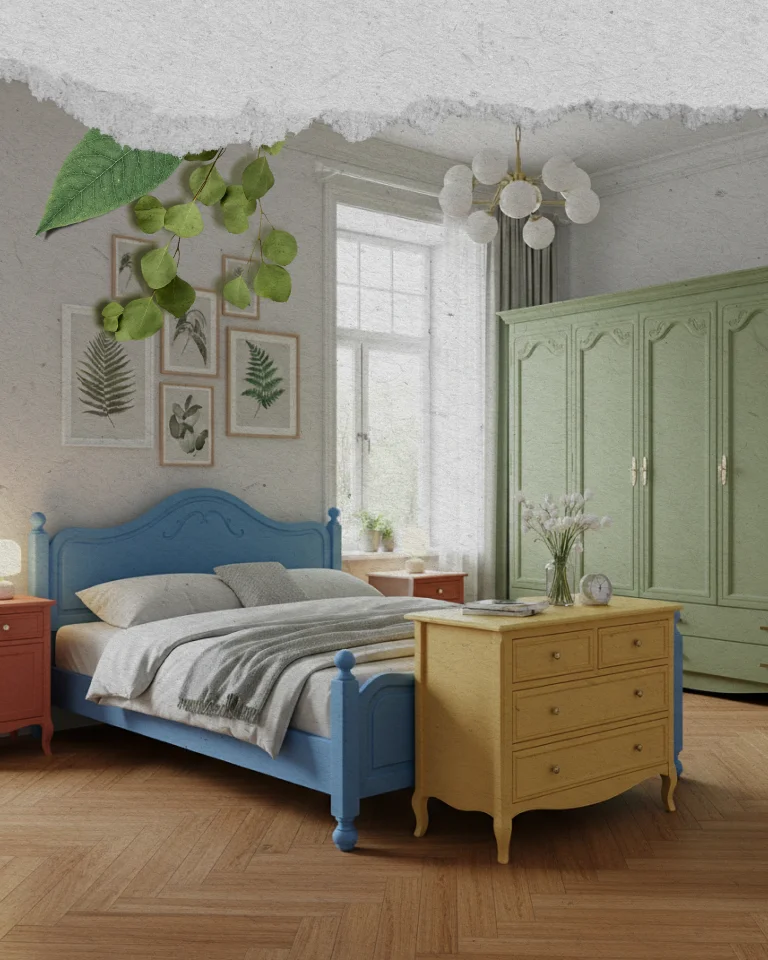
Take a photo of the room you’d like to furnish. For testing, I downloaded a picture of a bedroom from the internet. Ask AI to remove any existing furniture and replace it with your newly ‘painted’ thrifted finds.
I prompted the following:
“Please arrange the furniture of the final picture that we made (the blue bed, the two orange cabinets, the yellow chest of drawers and the green closet) into this bedroom and decorate the bedroom nicely. Make sure there's a mattress and bedding on the bed that matches the style of the furniture.”
Refining is key. So make any adjustments you’d like. I told AI the following:
“Absolutely fantastic!! What if we made the furniture a little bit less pastelly, but a bit more saturated in colour?”
If you fall in love with the AI version, buy the second-hand pieces and start refurbishing. The AI tool you’re using can provide you approximate colour codes. But remember that AI makes mistakes. Bring the image to the paint shop and ask for professional advice.

You’re probably aware of the environmental costs of AI. The servers consume a lot of energy and water, so prompting useless stuff might not be the best idea, like ‘turn my husband into a baby version of Mario’ (okay, that’s perhaps not useless as all, but you get the point).
But, if AI can help you to choose a second-hand piece over buying new, the environmental benefit of reuse easily outweighs the footprint of a handful of prompts.
In other words, AI can be a surprisingly powerful ally in making thrifted choices easier.
We're always looking for the next generation of pioneers. If you know someone doing extraordinary work, in food, fashion, design, or beyond, tell us about them.