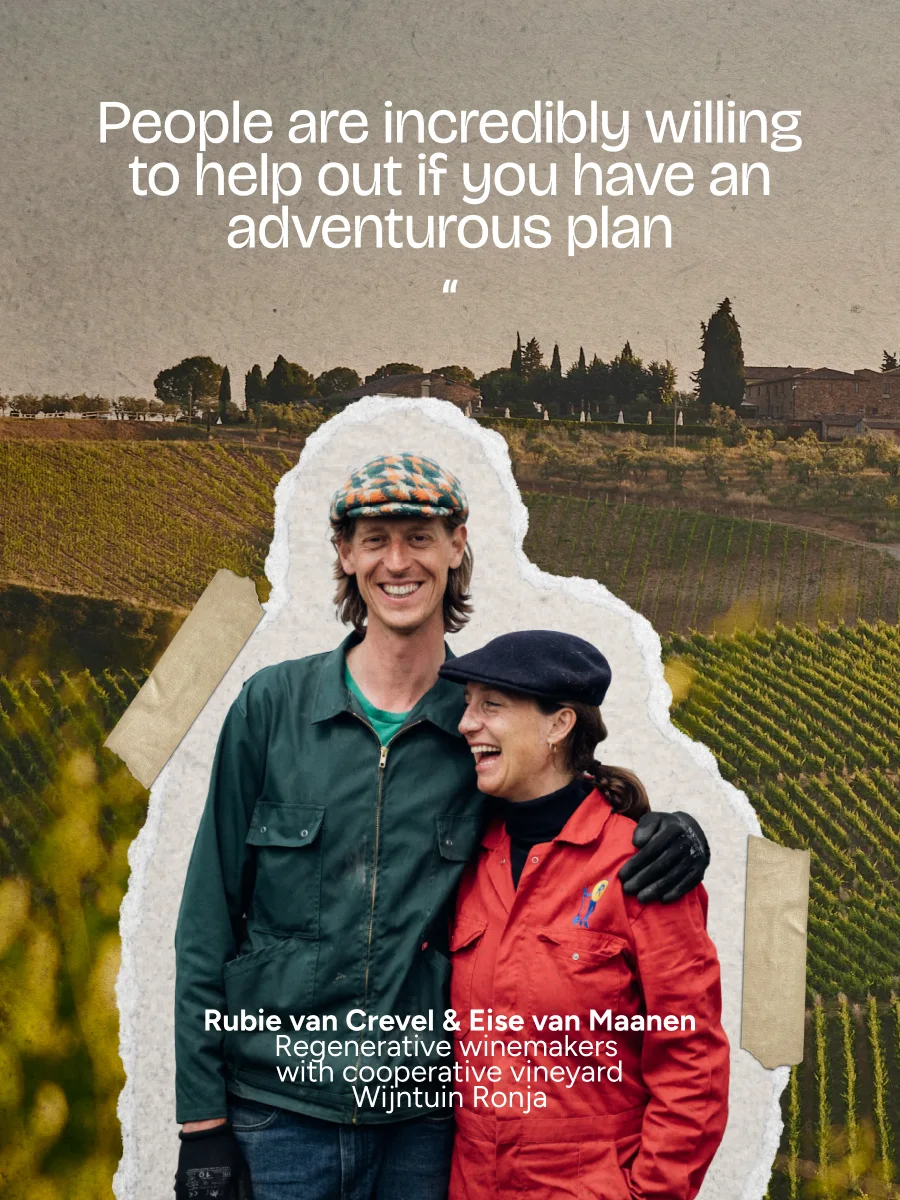
They were supposed to travel the world. Plan B: plant 888 vines

Early life

Sometimes, things begin when a plan falls apart. Rubie van Crevel (37) and Eise van Maanen (37) were about to travel the world. On the day of departure, the first COVID lockdown began.

They had time on their hands, and access to a piece of land. So they ordered 888 vines. Without experience or a real plan, they sent an email to friends and acquaintances: who wants to become a regenerative winemaker? Within a week, a hundred people signed up.

Five years on, around three hundred people are involved. Wijntuin Ronja, initially something temporary, in many ways still feels like a work in progress.

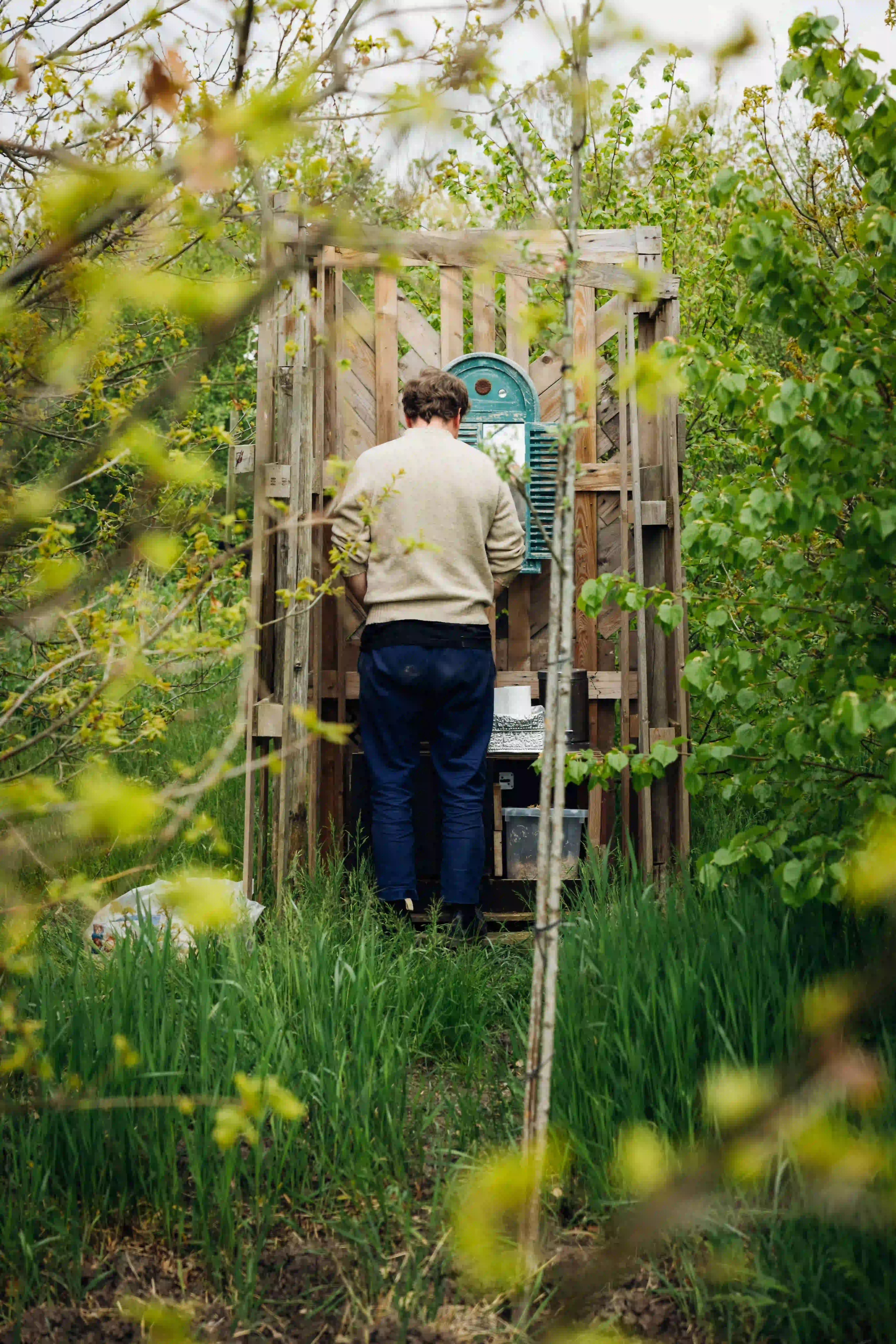
Photo by Jurre Rompa

Tell us Ruby, what is Wijntuin Ronja and how does it actually work?

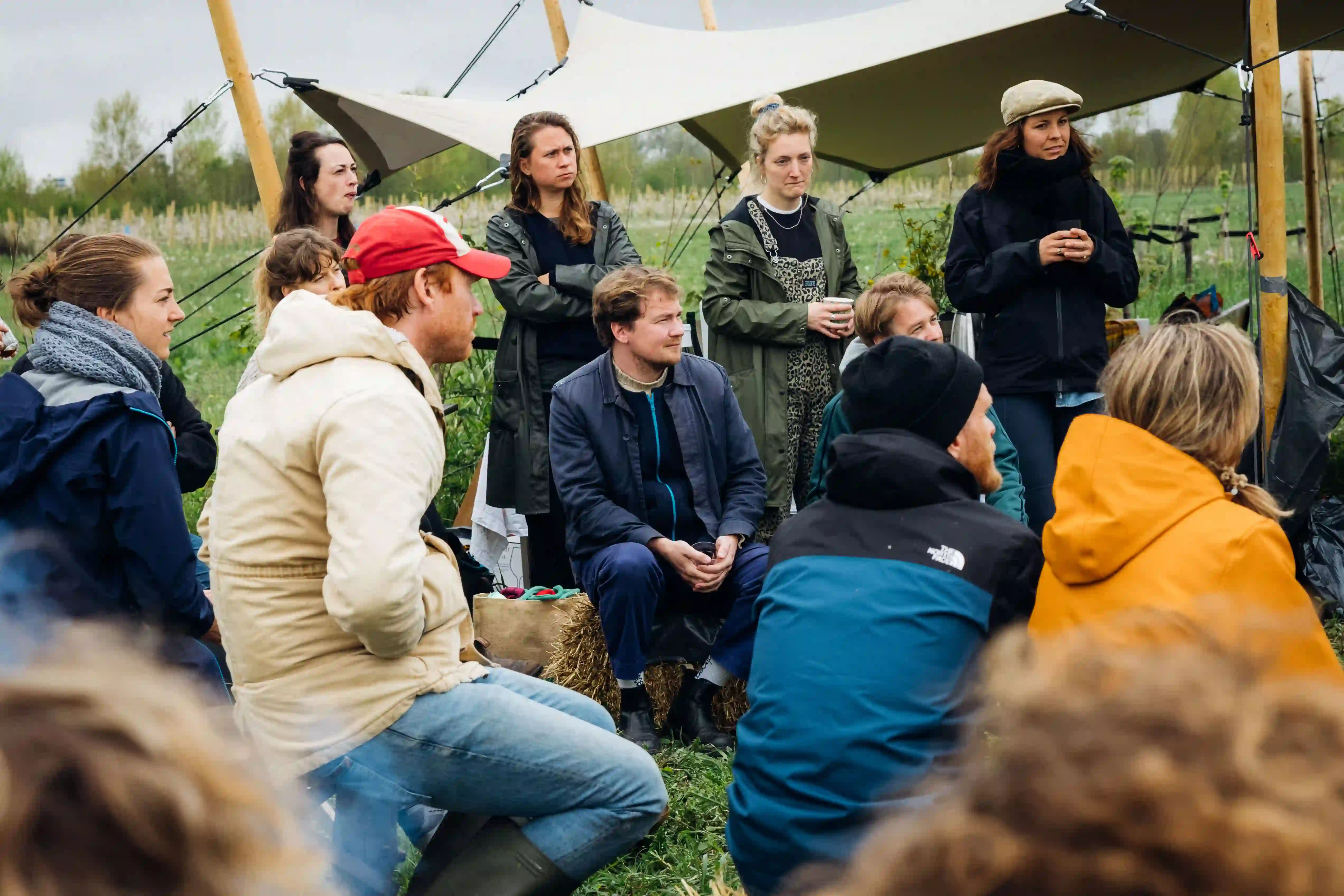
ā€˜Wijntuin Ronja is a collective vineyard. At the moment, we run it with around 300 wine farmers, people who help grow the grapes, learn with us, and shape the place together.

We started five years ago. From the beginning, it’s been about two things. On the one hand, we’re trying to make wine in a regenerative, nature-inclusive way, which is already quite experimental in the Netherlands. Because of the climate, there’s a lot of fungal pressure, so even conventional wine-making is not straightforward here. We’re constantly thinking about how we can improve the soil, increase biodiversity, work without chemical pesticides and artificial fertilizers, and try to rely on natural processes.

The other side of it is the collective. In the first years, that was almost as big of an experiment as unravelling regenerative wine making. How do you maintain a vineyard together? How do you share knowledge, divide the work, make sure people stay involved?'
"We still laugh about how little we knew in the beginning."

Ruby van Crevel

How did you end up here, starting a vineyard without experience?

We didn’t really set out to start a vineyard. My background is in political science. Eise and I both worked at the UN, and in several other jobs related to sustainable finance and social entrepreneurship. At some point, we both became interested in regenerative agriculture, but I also had a desire to do something hands-on with it. Working with the land, producing something tangible. Eise is an economist, and he’s always been interested in alternative models: how you can organise things differently to create impact. That all came together in Wijntuin Ronja.

We actually planned to travel the world to explore food projects. But then the lockdown happened, and suddenly we were here. We were offered the opportunity to use a piece of land, and because everything else had stopped, we thought: why not just begin?

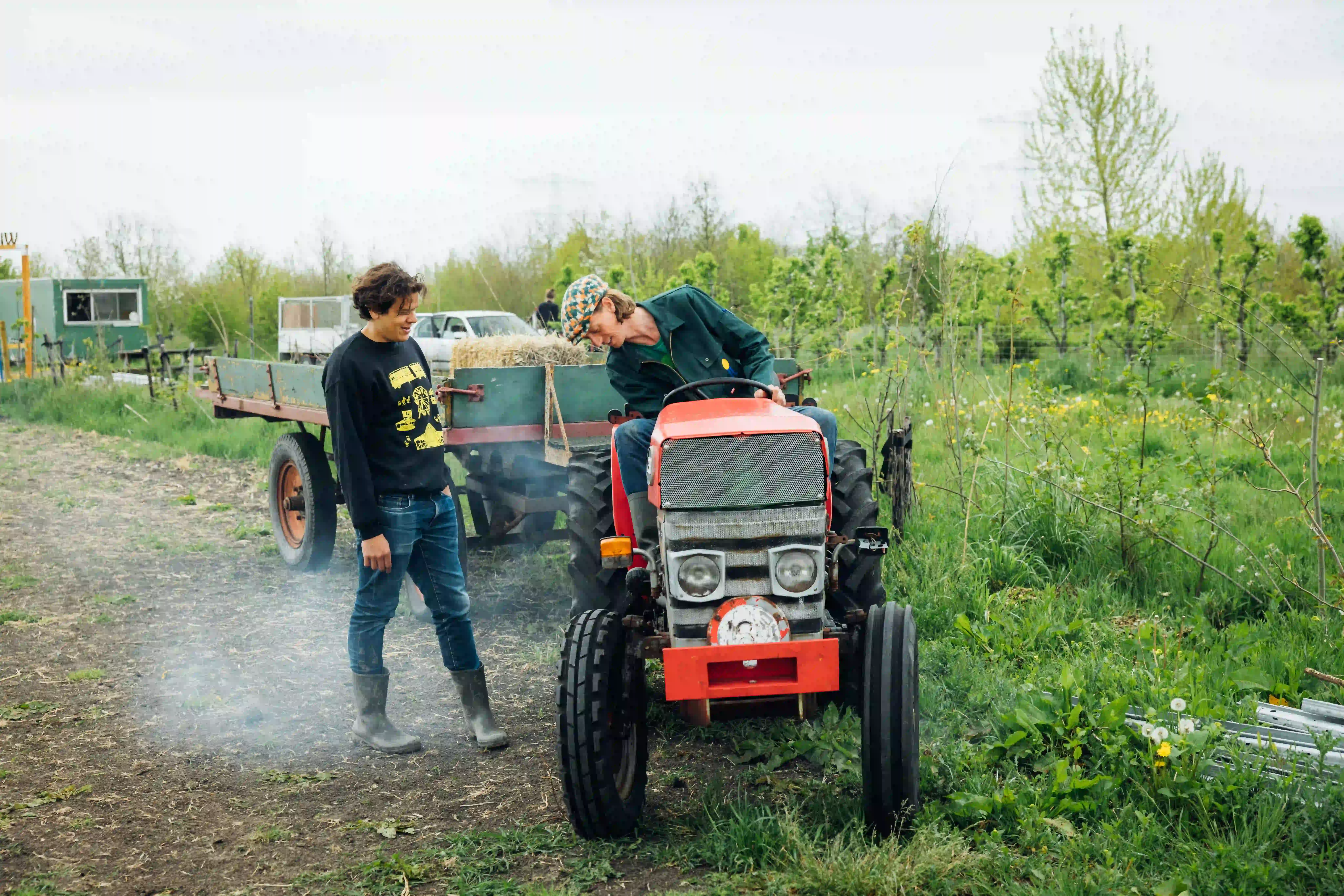
We started without any knowledge. We connected ourselves to a few mentors – experienced wine growers in the Netherlands – who helped us along the way. But in practice, it was a lot of figuring things out as we went. At the start it was quite adventurous, and perhaps a little naive. We still laugh about how little we knew in the beginning. But at the same time, people are incredibly willing to help out if you have an adventurous plan.

Photo by Jurre Rompa

Photo by Jurre Rompa

Why wine, specifically?

There’s something about wine that makes it interesting to work with. It’s quite mysterious. There are so many variables in how you grow the grapes, but also in what you do in the cellar. You can approach it in very different ways, and there are all these theories about what influences the outcome. But it’s never completely predictable. That makes it interesting, and let’s be honest: often very tasteful.

At the same time, it’s also something very social. People come together around it. It’s festive, in a way. That combination, something quite complex and agricultural, but also something people share and enjoy, really appealed to us. And because we were starting from zero, it also felt like something we could explore over a long time. There’s always more to learn.

Can you tell us more about the collective?

In the first five years, it was really about Ā the mystery of cultivating vines and producing wine in a collective manner. A diverse group of people joined, including sommeliers, vinologists, landscape managers, gardeners, wine lovers, and other enthusiasts. Together, we developed a shared knowledge base on how to cultivate grapes regeneratively in the Netherlands: on heavy clay soil, using low-tech, small-scale methods.

Our community-supported model allowed us to experiment more and take more risks. Our income didn’t depend on it. It gave us the freedom to try things, and to use this place not just to make wine, but to figure out how this way of working could actually function.

At the same time, we were well aware that this is not an easy way to make a living. Building a fully profitable vineyard requires very different choices: more events, higher production, and greater optimization. That’s not what we set out to do. Our focus has been on testing and refining small-scale regenerative viticulture in the Netherlands, while regenerating three hectares of degraded agricultural land into a highly biodiverse vineyard.

"Eise and I have recently realised that we’ve become a limiting factor."

Ruby van Crevel

How is the collective evolving now?

We’re moving into the next phase. We’re formalizing and further developing the way we are organized by setting up a cooperative, starting with 40 very diverse people, varying from sommeliers, journalists, retired agricultural experts to nature and gardener lovers. It will be a new level of experimenting with our collective way of organizing.

The shift is quite fundamental. In the past, we offered a community-supported program built around participation: giving people a taste of life as a winegrower through workshops and three days of work in the vineyard each season. By setting up the cooperative, we will also share the ownership with a group of 40 people. Not just of the land, but of the decisions, the responsibilities and everything that comes with making wine and regenerating 3 hectares of degraded land. We’ve organised ourselves into different working groups. Some focus on the vineyard itself – pruning, maintenance – others on more practical things, like building infrastructure, and others on the community or the workshop programme

Eise and I have recently realised that we’ve become a limiting factor. We both have other work and a family, so there’s only so much we can carry. There is a lot of energy and ideas amongst the participants, and this way it can actually move. At the same time, we really believe in this model. Power tends to concentrate. A cooperative is a way to decentralise power and organise things more collectively, while building commitment. That’s something we want to explore here, in practice, and hopefully contribute to learnings that will inspire others to organise themselves more collectively.

Was there a moment when you thought: this might not work?

Of course! We have quite heavy clay soil, which is compacted due to intensive agricultural practices prior to the start of the Wijntuin. The soil therefore holds a lot of water or shows cracks in periods of drought. After a very wet winter, a lot of the vines were standing in water. That’s something you really don’t want, because it can lead to root rot. So at that point we did think: maybe this is just not the right place for a vineyard.

But we didn’t give up. We started looking for ways to deal with the water instead of trying to fight it. We dug these natural drainage channels, wadis, across the land. Now they collect the water and slowly release it. And it actually made the landscape more interesting as well. In the summer we can seed them with flowers.

Those kinds of moments are quite typical. You run into something, you think: this is a real problem. And then you have to find a way to work with it. It’s magical, really.

Photo by Jurre Rmpa

What has Wijntuin Ronja taught you and what do you do differently because of it?

That nature is always in charge. In the beginning, we approached this project quite systematically. You try to plan everything, but in practice, it just doesn’t work like that. Everything depends on the weather, on the season, on what the plants are doing.

At the same time, it’s also where our choices become very visible. We don’t use synthetic pesticides or fertilisers and we try to work with as little external input as possible. That means you can’t just ā€˜fix’ things when something goes wrong. If there’s pressure from fungi, or if growth slows down, you have to look for other ways. That takes more time, and it comes with more risk.

But it also forces you to understand the system better. To work with it, instead of trying to control it. I think that’s the main shift. Letting go of the idea that you can fully manage it and learning how to respond adaptively instead.

What do you want people to take away from being here?

That they can be part of something. I think a lot of people are quite far removed from how food is produced, or from working with the land in general. Here, you’re not just a visitor, you’re involved. You see how things grow, but also how things fail.

At the same time, it’s also just a place where you can be outside, slow down a bit, be with other people. That combination feels important to us.

"The land doesn’t always cooperate, the conditions aren’t ideal, and there’s always some level of risk."

Ruby van Crevel

Where have you changed your mind since you started?

I think we’ve become much more aware of how complex agriculture actually is. There are a lot of ideas about how things should be done differently, and on paper, many of them make sense. But in practice, it’s often much more difficult. The land doesn’t always cooperate, the conditions aren’t ideal, and there’s always some level of risk.

So we’ve become more patient, I think. More aware that things need time and more focused on the long term. A grapevine can live for a very long time. So the decisions you make now, especially when it comes to pruning or shaping the plant, really affect what it will look like years from now. It changed how we work. Less focused on quick results, more on building something that can last.

Where do you hope this will be in five years?

That the whole area is fully planted – we’re at about fifty percent now – and that you really start to see the landscape change. More vines, but also more biodiversity, more crops in between. Something that feels layered, not just a vineyard.

We’d like it to become a place where different things come together. Not just wine, but also other products from fruit trees, maybe nuts. A kind of ā€œdrinks landscape.ā€ I also hope it simply becomes a better place to be. More mature, more settled. Somewhere you can spend time. Space for people, for kids, for nature. And that we’ve found ways of making wines that really fit this place. Wines that come out of this soil, this climate.

And of course that the cooperative is fully alive. That it’s no longer dependent on us, but that people really carry it together. I think, mostly, we’ll look back and realise: this was the point where it started to take shape.

There are still a few spots left for new wine farmers this year!

Know someone who deserves to be celebrated?

We're always looking for the next generation of pioneers. If you know someone doing extraordinary work — in food, fashion, design, or beyond — tell us about them.

Nominate a Pioneer
Stay in the loop

Join the revolution.

Our very best stories, insights and alternatives to overconsumption, every month in your mailbox. Subscribe now and join the reloved revolution!