
Understand the real costs of owning an EV

We all love a good deal, right? When picking your next car, a good deal doesn’t simply mean picking a car with a low purchase price. That would automatically land you on a fossil fuel car. Looking at the total cost of ownership – the cost of a car over its entire lifetime – electric vehicles (EVs) are increasingly cost competitive.

Whether an EV or an internal combustion engine (ICE) vehicle is the most affordable option for you, depends on many factors. Let’s dive into the numbers. Don’t forget to scroll down to check what it means for your individual situation.

The short version

The initial purchase price of electric vehicles still tends to be higher than the price of comparable petrol or diesel cars, but that upfront gap is narrowing as battery costs fall, and more affordable models enter the market.  

And whereas insurance, tyres and faster depreciation can still make EV ownership more expensive in some cases, the general conclusion is that the lower energy costs, reduced maintenance needs and government incentives make EVs the wiser choice in most cases. And that’s even more true for used EV’s, that are generally a good deal due to used EV’s faster depreciation.  

Overall, the total cost of ownership is increasingly shifting in favour of EVs, particularly for medium-sized cars and almost all second-hand vehicles. The real cost depends heavily on where you live, how much you drive, where you charge, and what type of car you choose.

Over 30% of BEVs sold in 2025 were now below the average price of their ICE equivalents in Europe.

The price gap is closing, and many EVs are already cheaper

The most cited barrier for people to switch from internal combustion engine (ICE) vehicles to EVs is the higher upfront price of EVs compared to ICE cars. It is true that on average, EVs are still more expensive than ICE-cars: they carry a price premium of around 20%. Consumers have a median willingness-to-pay for cars of around €20,000 whereas less than 10% of available BEV models in Europe are priced under €30,000. 

Good news is that over the past decade, EV prices have fallen globally due to declining costs of battery manufacturing, as well as the introduction of new affordable models. In Europe, in 2025, the average price of an EV decreased for the first time, after years of increase, as CO2-targets push carmakers to introduce new affordable models, and as new Chinese models enter the European market. Over 30% of BEVs sold in 2025 were now below the average price of their ICE equivalents in Europe.  

In China, 70% of BEVs sold in 2025 were already cheaper than their ICE equivalents. Almost all small EVs are now cheaper than small ICE vehicles. However, the market for EVs shifts towards larger vehicles, and therefore, the average EV price fluctuates rather than drops. Not just in China, but globally. 

Driving an EV is way cheaper than driving an ICE-vehicle

Generally, it is estimated that EVs cost between 3 and 7 eurocents per kilometre, versus 11 to 14 cents for petrol cars. Both petrol and electricity prices fluctuate, and the costs of driving an EV also depends on whether you charge at home (typically cheaper) or on the road (more expensive). Still, it is safe to say that driving an EV is generally cheaper than driving an ICE vehicle.  

The rapid increase in fossil fuel prices throughout 2026 has made the price gap even bigger. Taking an average household electricity price of 31,24 cents per kWh and an average consumption of 16,9 kWh per 100 kilometres, it costs you 53 euros to drive 1000 kilometres in an EV. Taking as an example German petrol price in March 2026, driving that same distance in a petrol car would’ve cost you 160 euros.  

Even when electricity prices are higher or when a larger proportion of charging is done at more expensive public charging points, and even when oil prices drop, it’s very unlikely for the kilometre price of EVs to surpass that of ICE vehicles. When you drive an extremely heavy EV in sub-zero temperatures charged at a public fast-charger, it might happen.  

Subsidies, taxes and other benefits

To promote EV uptake, governments worldwide stimulate consumers to make the switch by either rewarding EV ownership or punishing ICE car ownership.  

There are subsidies for EV purchase, subsidies for EV lease, preferential tax rates on EVs compared to ICE cars (such as registration tax and road taxes), kWh-based pricing mandates, and so on. Some of these schemes lower the initial purchase price of EVs or increase that of ICE vehicles, helping close the price gap between the two. Other schemes lower the usage costs of EVs compared to ICE vehicles.  

The extent to which these policies apply to you depends entirely on where you live, so make sure to check your local and national policies.  

Concerns about battery health and the potential cost of major repairs make the purchase of an older electric car less appealing.

Maintenance and insurance costs

EVs consist of way fewer moving parts, and are therefore mechanically far less complex, than vehicles with an internal combustion engine. This makes scheduled maintenance generally much cheaper. Research shows scheduled maintenance costs of €824 per year for a petrol car (at 15,000 km/year) and €498 for BEV. Repairs are often easier as well, but due to scarcer EV technicians, laborious repairs can still be expensive.  

EV tyres are also more expensive, because they need to support the heavy weight of batteries, reduce rolling resistance to maximize driving range, handle instant motor torque, and reduce cabin noise. The price difference is around €30-80 per tyre, depending on the brand, dimensions, and vehicle class.  

And finally, insurance costs of EVs are still higher, although the gap is closing rapidly. That’s because new EVs are still more expensive than ICE vehicles (so replacement costs are higher), and repair in case of collision is costlier.  

All in all, mainly due to cheaper maintenance, American car owners report on average $9200 lifetime maintenance and repair costs for ICE vehicles and $4600 for BEV’s and PHEVs.  

EVs have a lower retention rate

The retention rate is a metric used to show the residual value of a car. It represents the value of the vehicle when being resold in relation to the original purchase value. A retention rate of 70% means that a product purchased new will lose 30% of its original value. 

In 2025, the retention value of BEV’s was around 37%, whereas that of PHEV and the total market was around 49%.

Rapid advances in battery technology have quickly made newer electric models far more attractive, accelerating the depreciation of older electric cars. While electric cars generally require less routine maintenance than conventional cars, concerns about battery health and the potential cost of major repairs make the purchase of an older electric car less appealing.  

This matters for your total cost of ownership: what it costs you to buy, use and get rid of your vehicle.  

Woodys Media via Pexels

Total cost of ownership

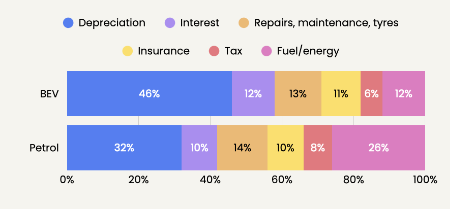
The number that matters most: total cost of ownership. It sums the total costs of owning a vehicle. From purchase to maintenance and repairs, to energy costs, depreciation (the value you lose between the purchase amount and the amount you earn when selling it on the used car market), insurance and taxes.  

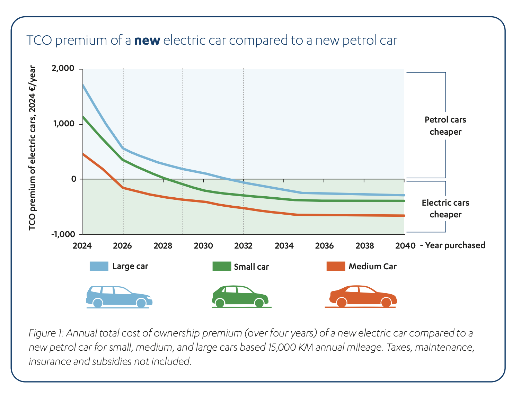
When looking at total cost of ownership, medium-sized EVs reach price parity (where the price premium you pay for an EV drops below €0) in 2026, meaning that as of 2026, medium-sized EVs will be cheaper than their ICE equivalents. Small and large EVs reach price parity around the end of this decade. This is under the assumption of a first-hand vehicle driving 15,000 kilometres a year. Tax, maintenance, insurance and subsidies are not included. These are often in favour of EVs, meaning reality is even more positive for EVs than the graph shows.  

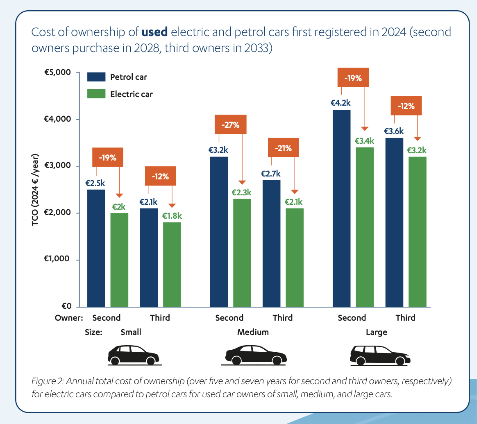
Second-hand and third-hand cars are already much cheaper in terms of TCO, for small, medium and large cars alike. 

Ayvens compares the cost of BEVs to the cost of other types of cars in Europe. In 17 out of 30 countries, BEVs are now cost-competitive. Portugal is the most affordable country in Europe for driving an EV, in Switzerland it’s most expensive. 

When looking at Europe, battery electric vehicles are now more cost competitive in the sub-compact car segment in Luxembourg (price gap of €232 per month), Portugal (€222), Denmark (€203), Switzerland (€177), Belgium (€158), Ireland (€102), Austria (€101), The Netherlands (€83), Finland (€33), France (€32), the UK (€24), Croatia (€21), Sweden (€17) and Spain (€2).  

Note that the Ayvens report was published in February 2026. Due to rising petrol prices, the price gas has very likely widened.  

So… What are the real costs of owning an EV for you?

The real costs of owning an EV depend largely on where you charge, the price of your electricity, whether you buy a small city car or a gigantic SUV. To give you a general idea though, we built the tool below.  

And remember: cost is not everything. There’s also the environment, the noise, the driving experience, and the coolness.  

Know someone who deserves to be celebrated?

We're always looking for the next generation of pioneers. If you know someone doing extraordinary work, in food, fashion, design, or beyond, tell us about them.

Nominate a Pioneer
Stay in the loop

Join the revolution.

Our very best stories, insights and alternatives to overconsumption, every month in your mailbox. Subscribe now and join the reloved revolution!