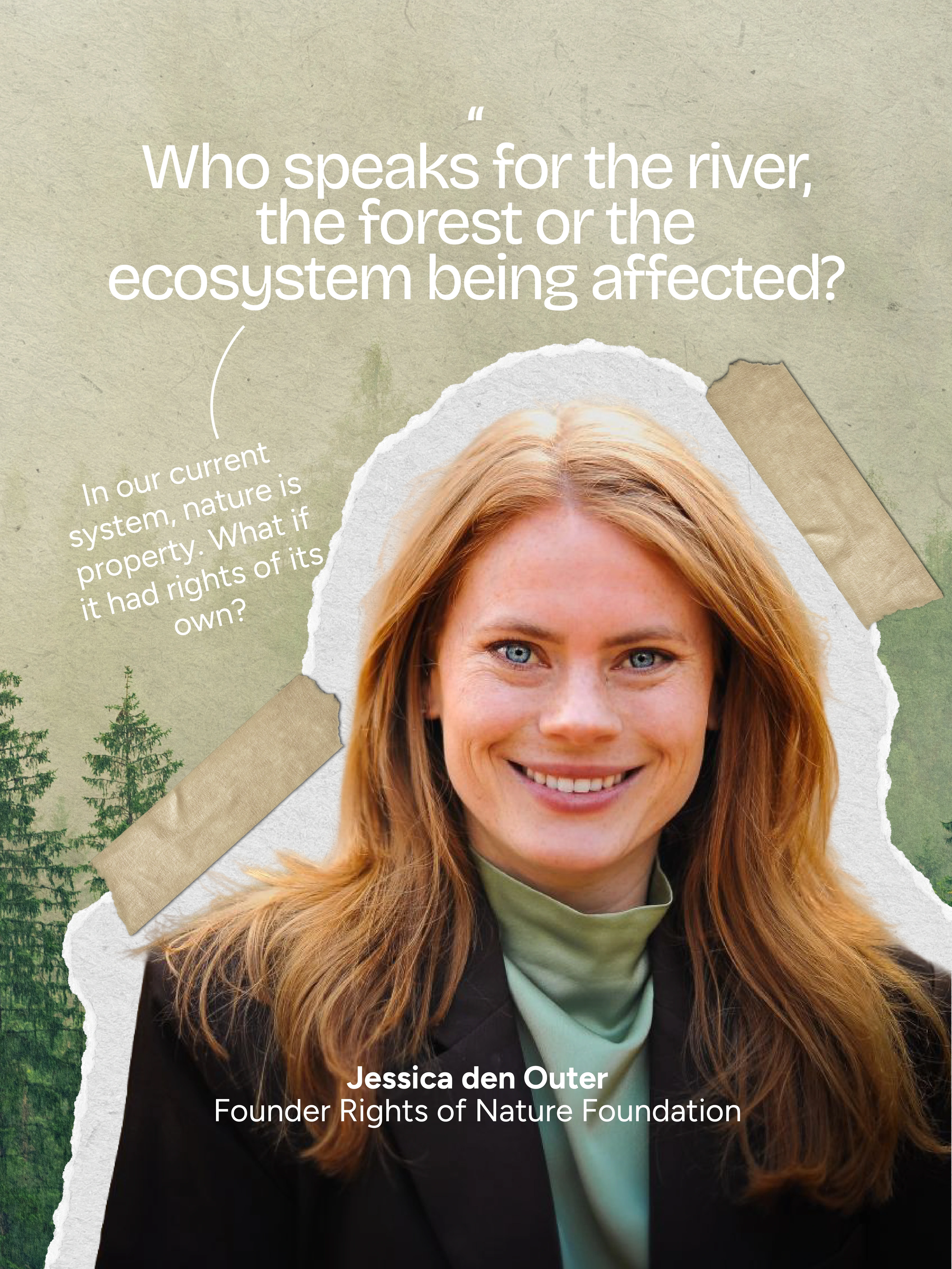
‘What does the forest think?’

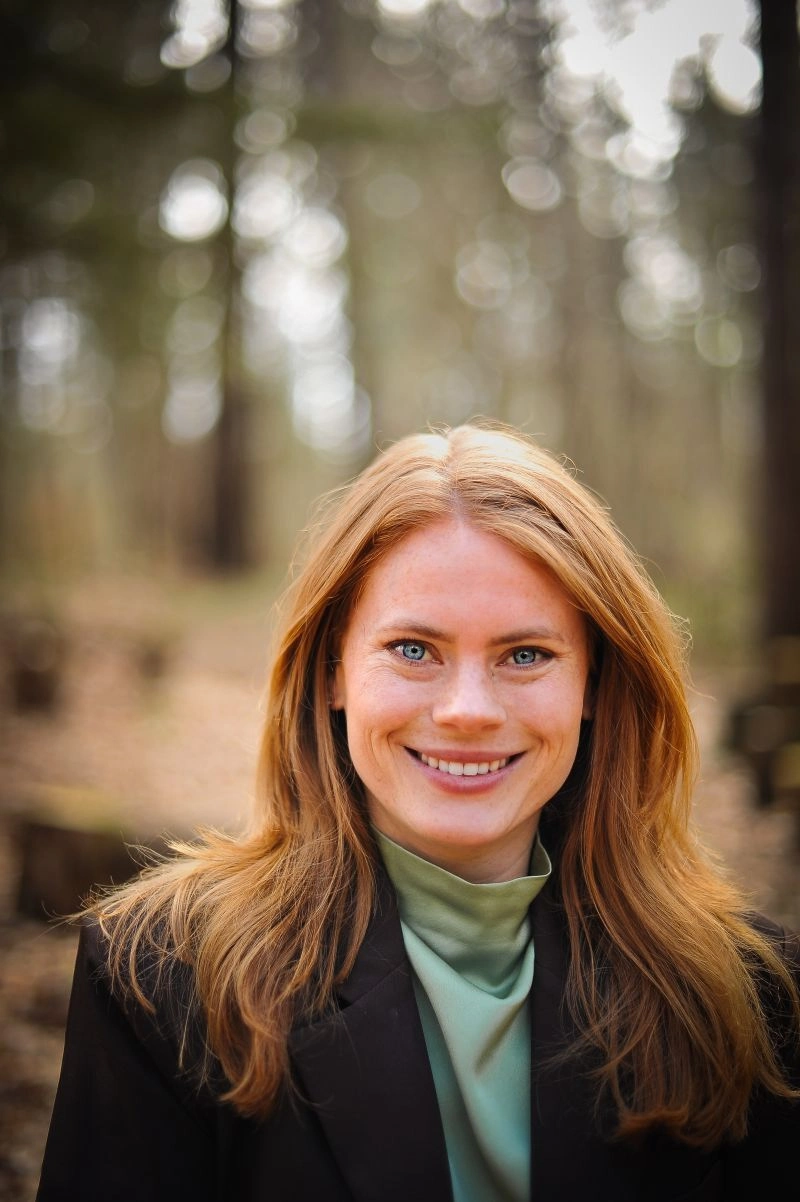
As a child, Jessica den Outer (30) would crawl through the garden with her grandfather, studying insects and plants for hours. Today, the Dutch nature advocate  has turned that same fascination into a legal mission: giving nature a voice in our political and legal systems.

Through her foundation Rechten van de Natuur and her work with the United Nations Harmony with Nature programme, she advocates for a radical shift in how humans relate to the natural world. Her ideas are also explored in her book Rechten voor de Natuur, which was recently translated into English as The Forest Fights Back, offering a deeper look into this emerging movement.

Where traditional environmental law often focuses on managing damage, Jessica wants a complete paradigm shift. ‘It’s time we start seeing nature as a stakeholder with rights of its own.’

Where did your connection with nature begin?

‘As a child, I was outside a lot. My grandfather and I would spend hours crawling through the garden together, looking at insects, plants, bees… entire tiny ecosystems most people never really notice. I remember being fascinated by the fact that there was this whole living world constantly unfolding around us.

That fascination stayed with me. At the same time, I grew up with a strong sense that you should contribute something meaningful to the world. My parents both worked in caring professions, and I think that shaped me a lot. Protecting nature never felt abstract to me. It felt personal.
‍

Right now, economic interests dominate our conversations. But if the ecosystem itself had legal representation, nature would no longer be an afterthought.

Jessica den Outer

When did you realise protecting nature through existing laws wasn’t enough?

During my environmental law studies, something started bothering me. Almost every law or policy was still built around human interests. Nature was something to protect because humans benefit from it economically, socially or physically.

You can even see it reflected in government communication around issues such as nitrogen emissions: nature needs to become more resilient so that economic development can continue. Once again, the focus remains on human interests rather than nature itself.

That became a turning point for me. I realised the issue wasn’t only environmental destruction itself, but also the legal worldview underneath it. In our current system, nature is treated as property or an object. In contrast, Rights of Nature says: what if nature itself has rights? What if rivers, forests or ecosystems are considered living entities with interests of their own?

NRC

Unknown

That still sounds pretty radical to many people. What would rights of nature actually look like in the Netherlands?

It’s less unrealistic or extreme than people think. Last year we published extensive research showing there are at least sixteen ways rights of nature could be implemented within the Dutch legal system.

That ranges from constitutional change to granting legal personhood to specific ecosystems. For example, the Wadden Sea could become a legal entity with appointed guardians representing its interests, similar to how guardians represent children.

Imagine major infrastructure decisions involving the Wadden Sea. Right now, economic interests dominate those conversations. But if the ecosystem itself had legal representation, nature would no longer be an afterthought.

What makes this approach fundamentally different from mainstream environmentalism?

A lot of environmental organisations work within the current system as effectively as they can, and that work is incredibly important. But the rights of nature go one step further. We’re not only trying to improve the system, we’re questioning the foundation underneath it. This shift has the potential to transform not only our legal systems, but also our culture, politics and the way we relate to the living world.

People often respond with: ‘So now we can never cut down a tree again?’ But that’s not what this movement is about. Rights of nature isn’t anti-human. Humans are part of nature too.

Jessica den Outer

Have you already seen signs that this shift is happening?

Yes, and honestly, that gives me a lot of hope. A few years ago, almost nobody in Dutch politics was talking about rights of nature. In 2023 there was one municipality actively exploring the concept. Now there are seventeen.

What’s especially interesting is why municipalities become interested. Many local governments are experimenting with citizen participation and democratic renewal. Eventually they realise: every stakeholder is represented except nature itself. Businesses are at the table. Residents are at the table. But who speaks for the river, the forest or the ecosystem being affected? That awareness alone already changes conversations.

What is the biggest misconception about rights of nature?

That it would immediately lead to endless restrictions or unrealistic rules. People often respond with: ‘So now we can never cut down a tree again?’ But that’s not what this movement is about. Rights of nature isn’t anti-human. Humans are part of nature too.

Another misconception is that rights of nature automatically belongs to one political side or only appeals to activists. But healthy ecosystems affect everyone, regardless of ideology. I’ve seen support come from people with very different political backgrounds, because clean water, healthy soil and a livable future are universal concerns. At its core, this movement is not about being left or right but about rethinking our relationship with the living world.

Building a movement like this can’t have been easy. Did you ever doubt yourself?

Definitely. Especially in the beginning. A lot of my former classmates went into corporate law firms. They had stability, financial security, clear career paths. Meanwhile, I was trying to build something that barely existed yet.

After graduating, I moved back in with my parents because I simply couldn’t make this work financially. At the time, I found that quite confronting. Especially being in your twenties, it’s so easy to constantly compare yourself to others. But over time, I realised that success means something very different to me. For me, success is waking up each day feeling that my work contributes to something meaningful.

You’ve also spoken publicly about sexism and online attacks. How has that affected you?

It still affects me sometimes. Especially because the criticism often has nothing to do with the actual content of my work. People comment on my appearance, my voice, my femininity: things male experts rarely have to deal with in the same way. I’ve had moments where it genuinely made me doubt whether I wanted to keep speaking publicly.

But at the same time, I remind myself that every major social movement was once dismissed as naïve or unrealistic. Women’s rights, abolition of slavery, environmental protection: all of those ideas were heavily criticised in the beginning too.

People comment on my appearance, my voice, my femininity: things male experts rarely have to deal with in the same way.

Jessica den Outer

How do you personally stay hopeful while working on such enormous issues?

I try to stay very connected to daily life and to nature itself. I walk a lot. I kickbox. I spend time with friends and family.

I don’t believe people change through guilt and shame alone. You can’t spend every second of your life being morally perfect. I’m not interested in being preachy. What I do believe in is creating conversations that make people genuinely curious. Once people start asking different questions like ‘What does nature itself need here?’ something begins to shift.

What does success ultimately look like to you?

I think the legal changes are only the beginning. What really excites me is the deeper cultural transformation underneath it.

In Spain, for example, the Mar Menor lagoon became the first ecosystem in Europe with legal personhood. Afterwards, people started relating to that ecosystem differently. They started speaking on behalf of it, caring for it in a more personal way.

That’s the future I hope for: a society where nature is no longer seen as something separate from us or secondary to economic growth, but as something alive that we are fundamentally connected to.

What can someone reading this do tomorrow to contribute?

Start locally! In the Netherlands, citizens can speak during local council meetings. Imagine speaking not only as yourself, but also on behalf of a forest, a river or a green space in your area. For many policymakers, hearing someone say: ‘I’m speaking today on behalf of this ecosystem,’ completely changes the dynamic in the room. Big societal shifts often begin with small moments that challenge how we see the world.’

Know someone who deserves to be celebrated?

We're always looking for the next generation of pioneers. If you know someone doing extraordinary work, in food, fashion, design, or beyond, tell us about them.

Nominate a Pioneer
Stay in the loop

Our very best stories, insights and alternatives to overconsumption, every month in your mailbox. Subscribe now and join the reloved revolution!

Thank you! Your submission has been received!
Oops! Something went wrong while submitting the form.